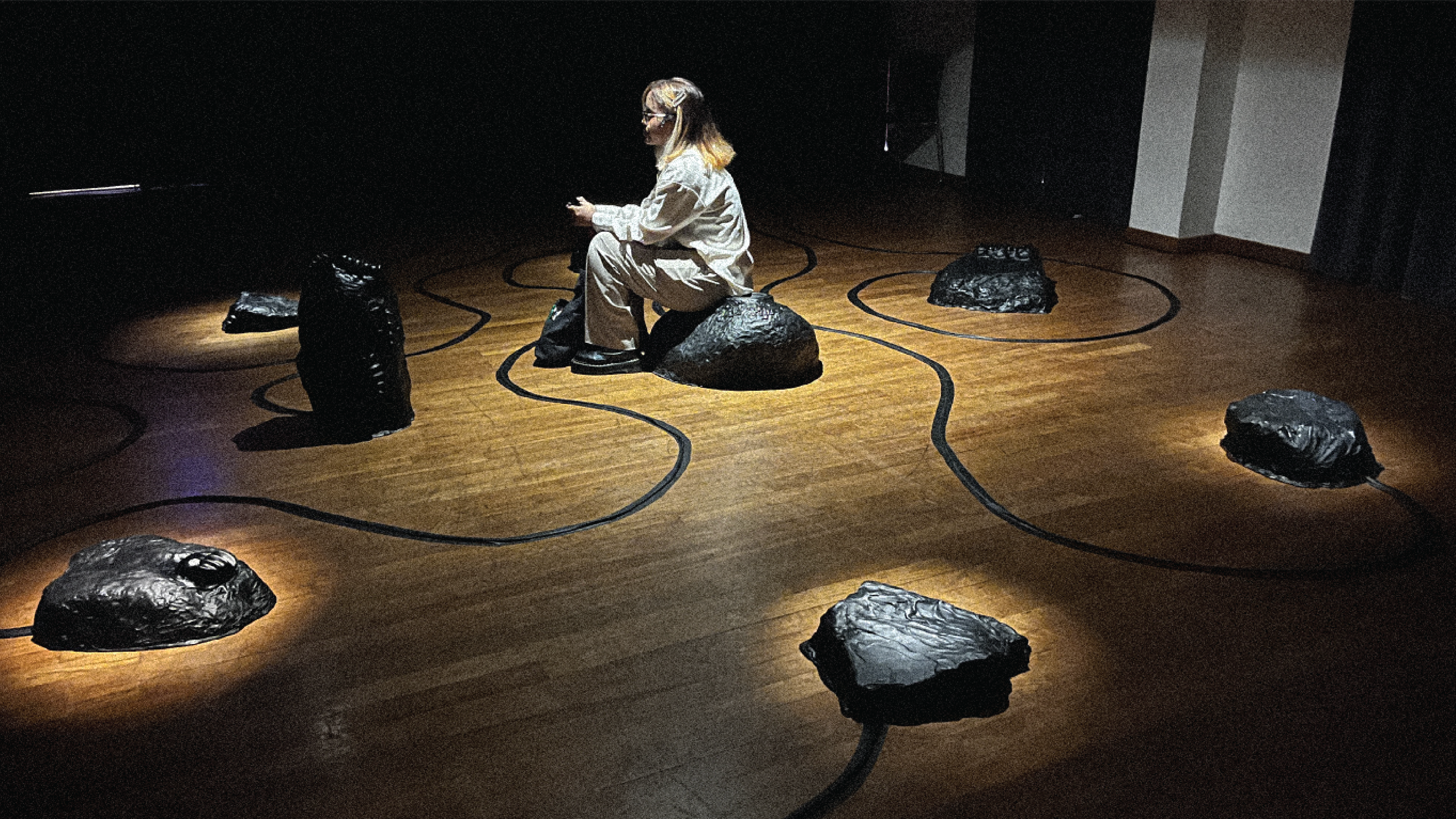
Homing by Anaparn, part of the Auditoria exhibition at SAW
Feedback from last week’s explorations
Recapping last week's experiment, I consulted Andreas on my touch-clay-sound experiment and the sound for my Vibrational Ground experiment.
As expected, the feedback on the sound was lukewarm. The concept behind the sounds was interesting, as playing back the environmental recordings felt like capturing a memory, which was more meaningful than random low-frequency beats. However, the sound itself was too pitchy and aggressive, which didn't adequately convey what I intended. This was likely because of the audio sampling process and the way the exciters were mounted, as I had only used double-sided tape, which felt flimsy.
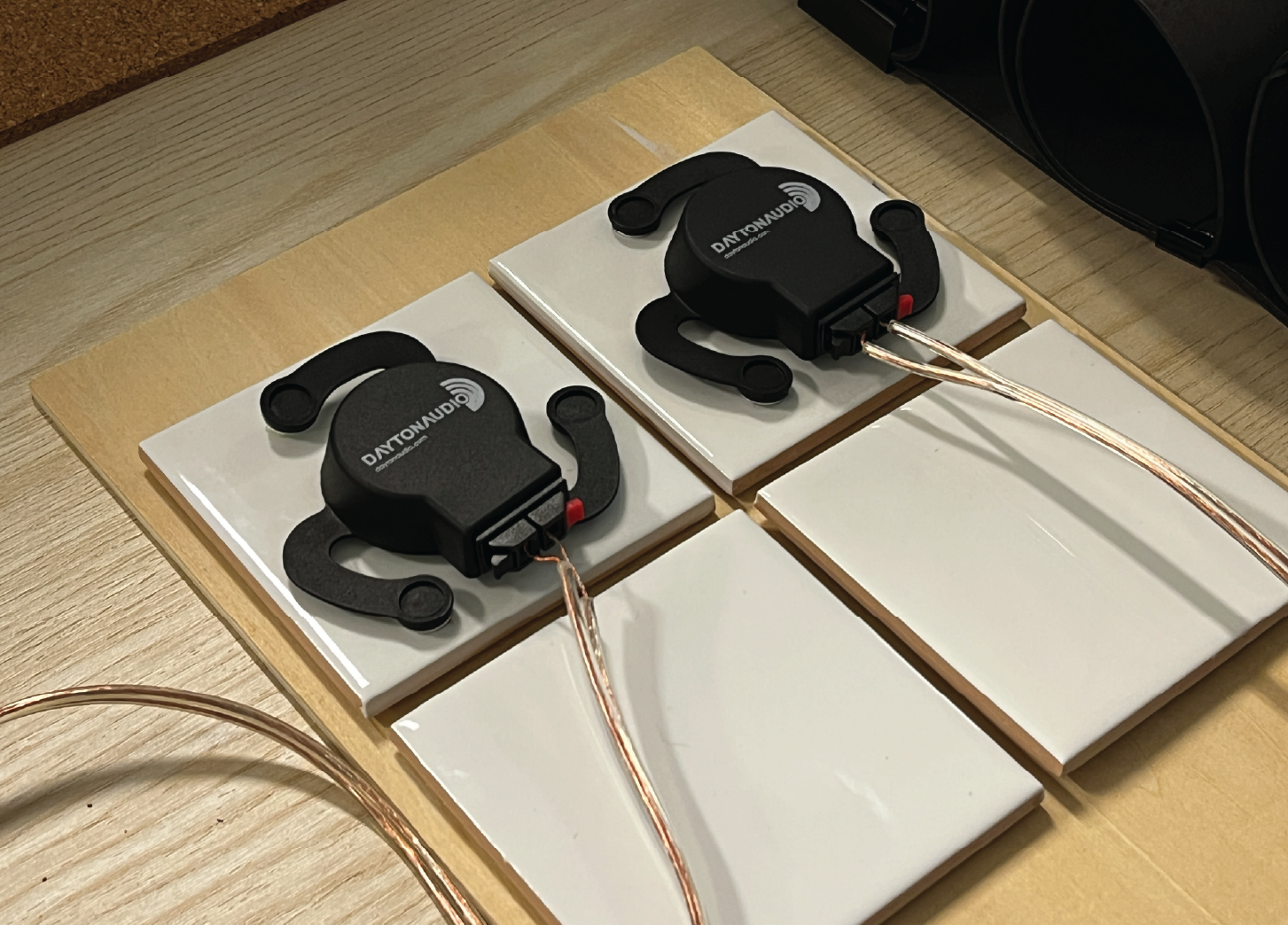
Attempting EVA foam and porcelain tiles as a base for the exciters
As for the sound, the alternative was to go back to computation and try using Strudel again to code my own rendition of low-frequency sounds, just like what I did in Semester 1. This way, the track becomes easier to control and more organic in development. The key question was: do I want the final sound to be a playback of the original sample? Meaning, playing back the collected sound as a memory of the sounds we hear in our daily surroundings. It could fall a little flat, but would be more understandable for a first-time viewer. Another option was to combine both the collected and computed sound together for some sense of balance.
Generally, there should be a context to the overall sound to tie everything together conceptually, not random samples chosen for no reason. If I did a version that was purely computational (coded with Strudel), it might come off as abstract. By mixing both, there needs to be a fine balance between what's sampled and what's coded.
Material-wise, the porcelain tiles and wood didn't feel quite right, as they did not convey the same effect as the pillow done in Semester 1. Instead of subtle and slightly intriguing, the materials used this time felt rigid and unwelcoming, which was not what I wanted.
Pondering about the future
Technicalities aside, Andreas also asked me to think about how this project could land me a job
in the future. Where do I see myself after graduation?
To be honest, this question took me by surprise. After close to a year of creative freedom and experimentation with this project, I realised I had been subconsciously avoiding a looming fear: graduation, and returning to the working world to face reality.
I told him that ideally, branding is what I know best so naturally, I might return to that field.
At the same time, the experiences and works I’ve realised over these three years have also drawn me towards experiential design and interdisciplinary arts. Designing flat layouts and 2D graphics simply won’t cut it anymore – I might look into residencies where I can try out my own kind of experiential design, if I could.
Going back to the project itself, I intend to develop a central exhibition identity to link all my experiments in a cohesive manner. Andreas added that I could also think about cultural interfaces, to build on familiarity. Ultimately, I am creating experiential exhibition pieces, in an effort to probe people to listen a little deeper to their daily environments.
Exhibition, Inspiration, Drop in the Ocean
Speaking of exhibition, I did a little recap of the works that inspired Vibrational Ground along the way. I think they are worth revisiting:
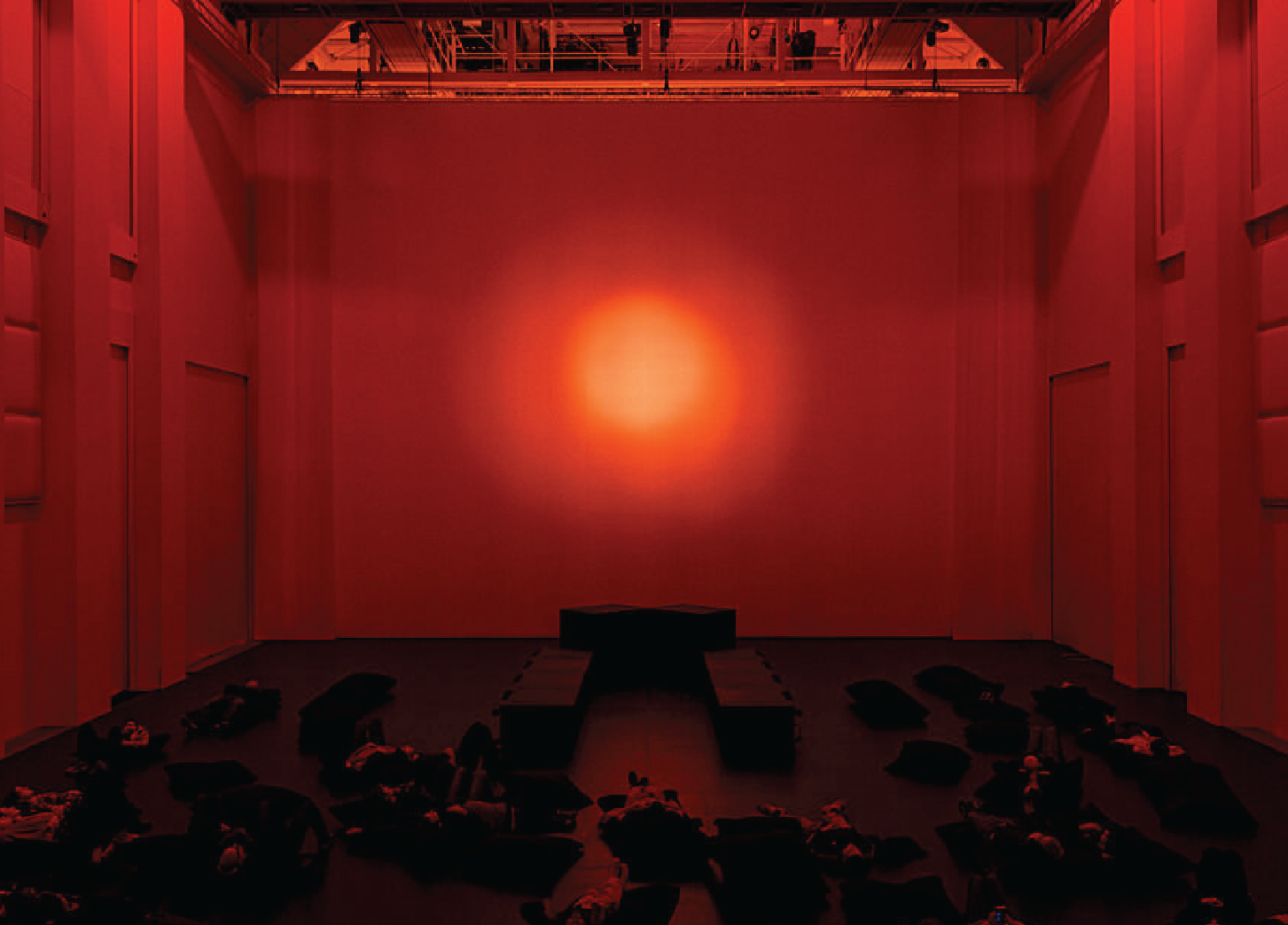
Bodies and Subwoofers (B.A.S.) by Stefanie Egedy is a series of site-specific installations and concerts that use subwoofers and low-frequency sound to create vibrational, full-body listening experiences. Each composition is designed to the architecture of the space, working with the room's natural resonances and reverberations.
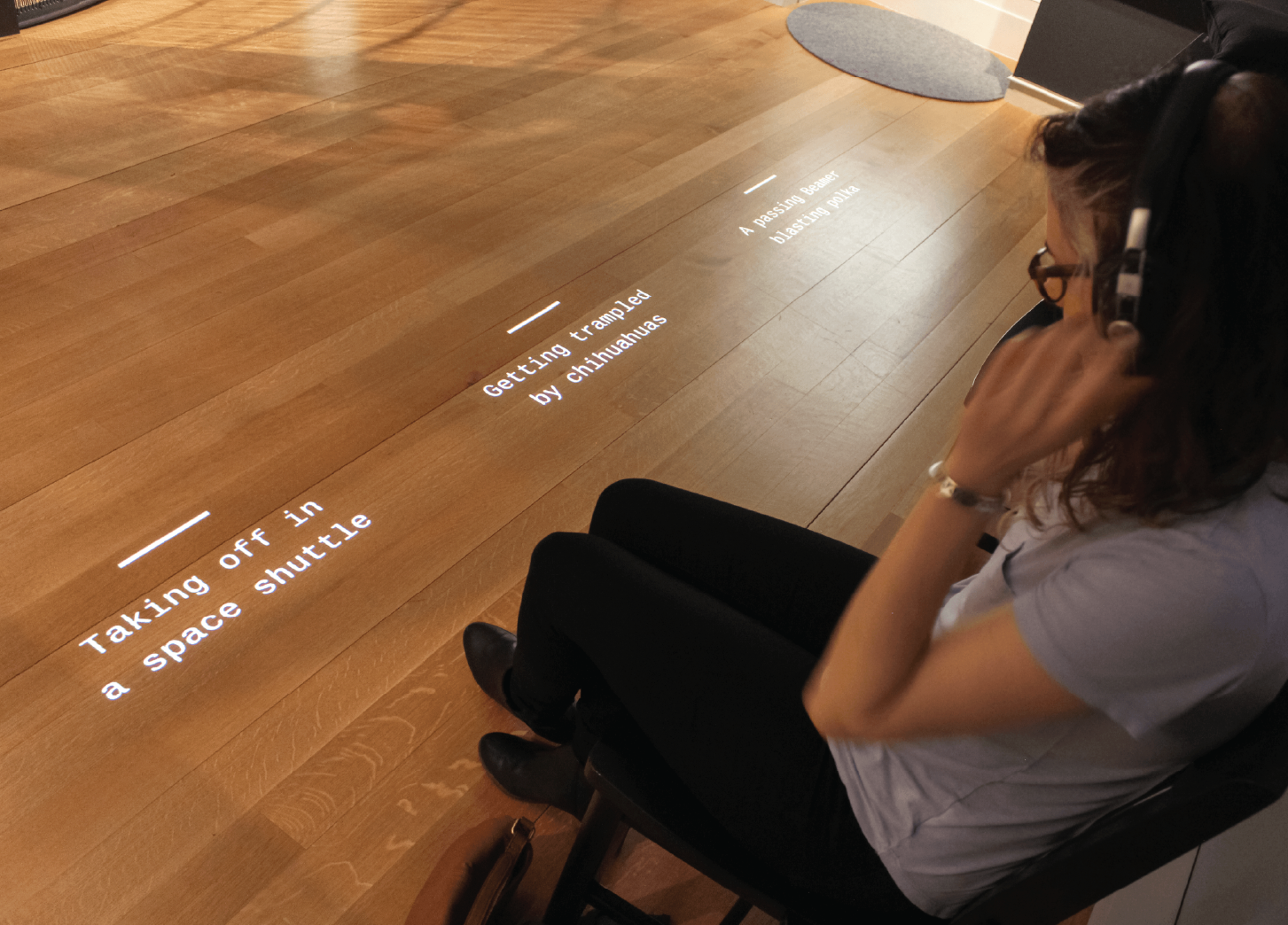
Seated Catalog of Feelings
by Eric Gunther is a multisensory installation that transforms ordinary chairs into vessels for extraordinary sensations. Using tactile vibrations paired with evocative text, this one’s super interesting because visitors can actually feel over 100 sensations, such as “falling backward into jello”.
Singapore Art Week
This week, I set aside some time to go visit Singapore Art Week, as there were quite a few sound-related installations I wanted to see.
While there, I came across a work that felt similar to my Vibrational Ground experiment. Homing by Anaparn is a sound sculpture installation that uses bass shakers encased in eight sculptural forms, designed to be experienced through the body rather than through conventional listening. The work invites the audience to touch, feel, sit, or stand on them, as each sculptural form has a unique vibration.
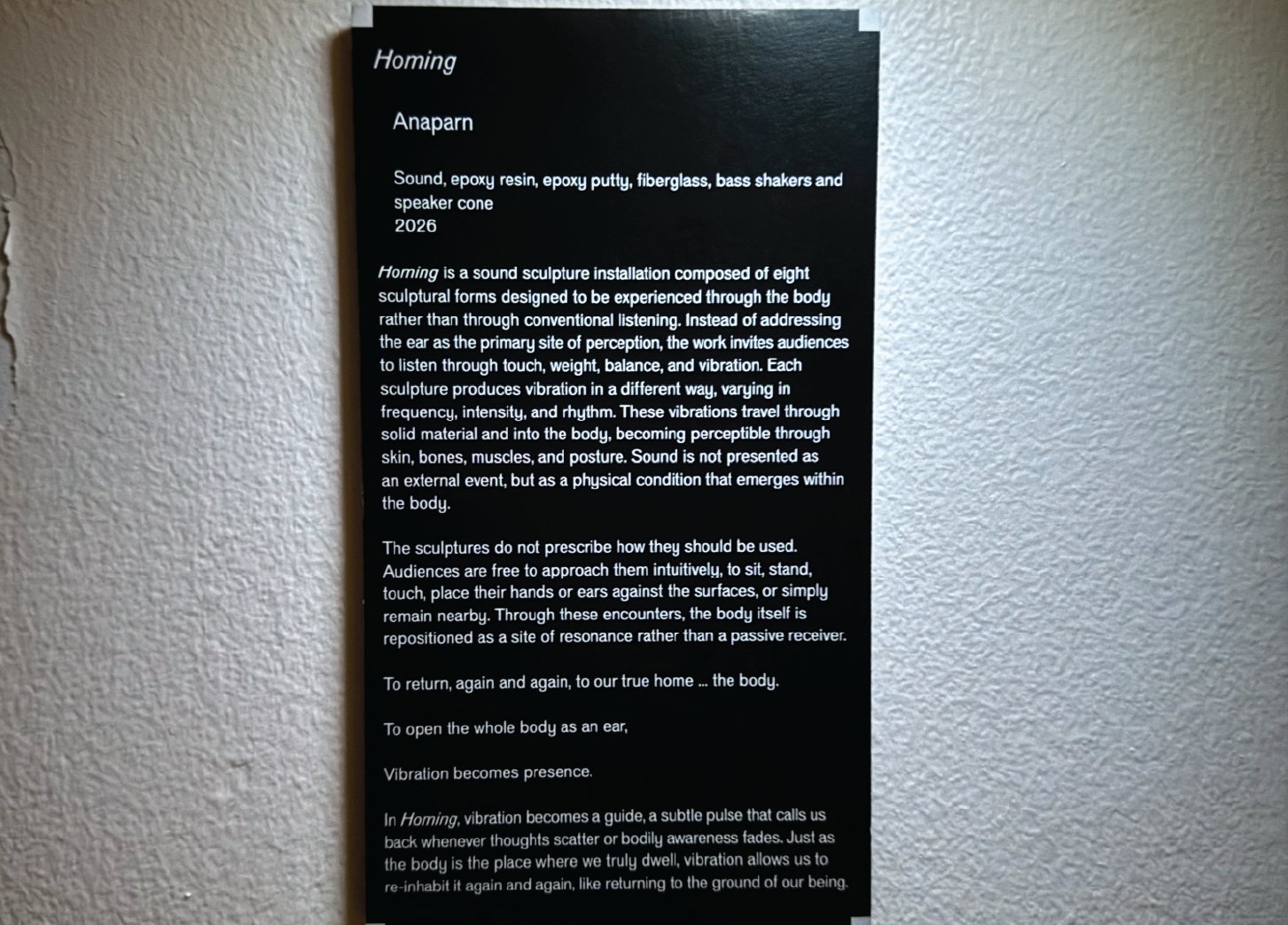
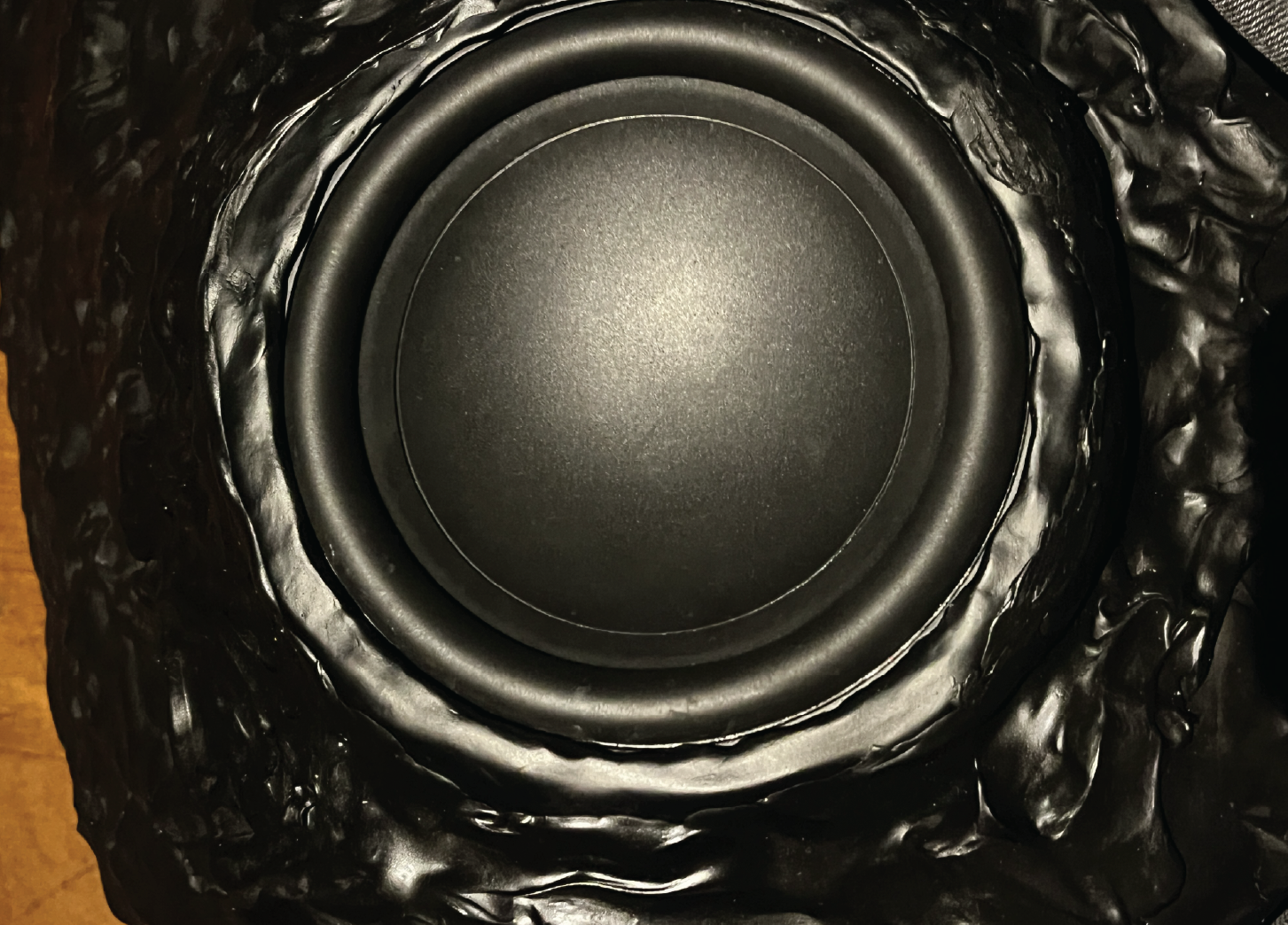
It was surreal touching and sitting on these forms, as the vibrations were pretty perceptible and the rock-hard surface really expressed them well. While experiencing the work, it made me think about the idea I was exploring just a week ago. It really would be interesting if the vibrations weren't so abstract, or if there was more context to the sound going through each form.
Overall, it gave me hope for my experiment, as the rawness and tactility of touching and feeling sound at its most fundamental, down to the vibrations themselves, was such a grounding encounter.