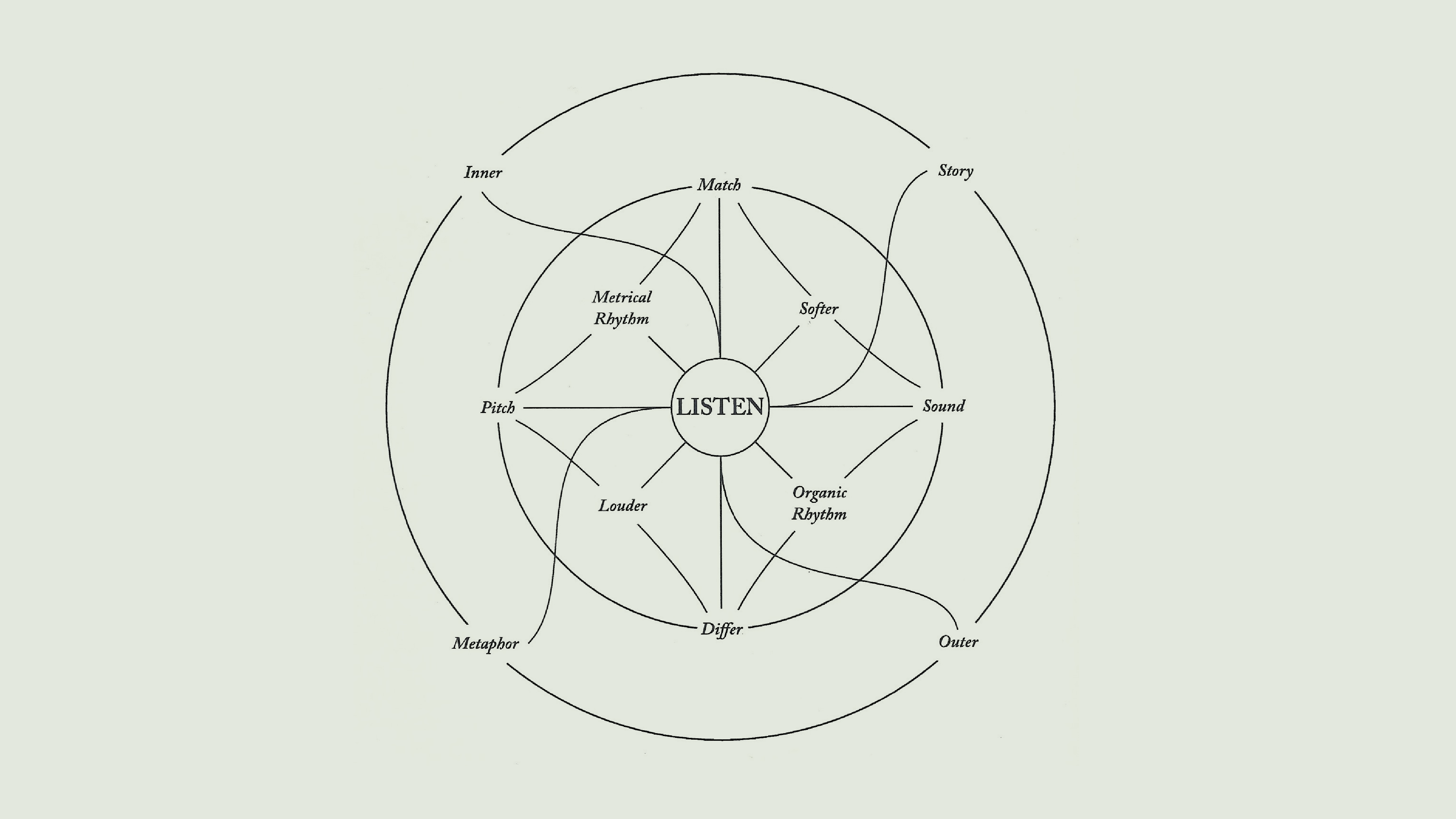
Pauline Oliveros, Wind Horse. 1990, text score
Understanding and looking back on things
After a week of contextual pondering and fighting back the inertia of making, I still had no clear sense of how I wanted to link everything together into a cohesive project.
Of course, the answer to this problem is always making.
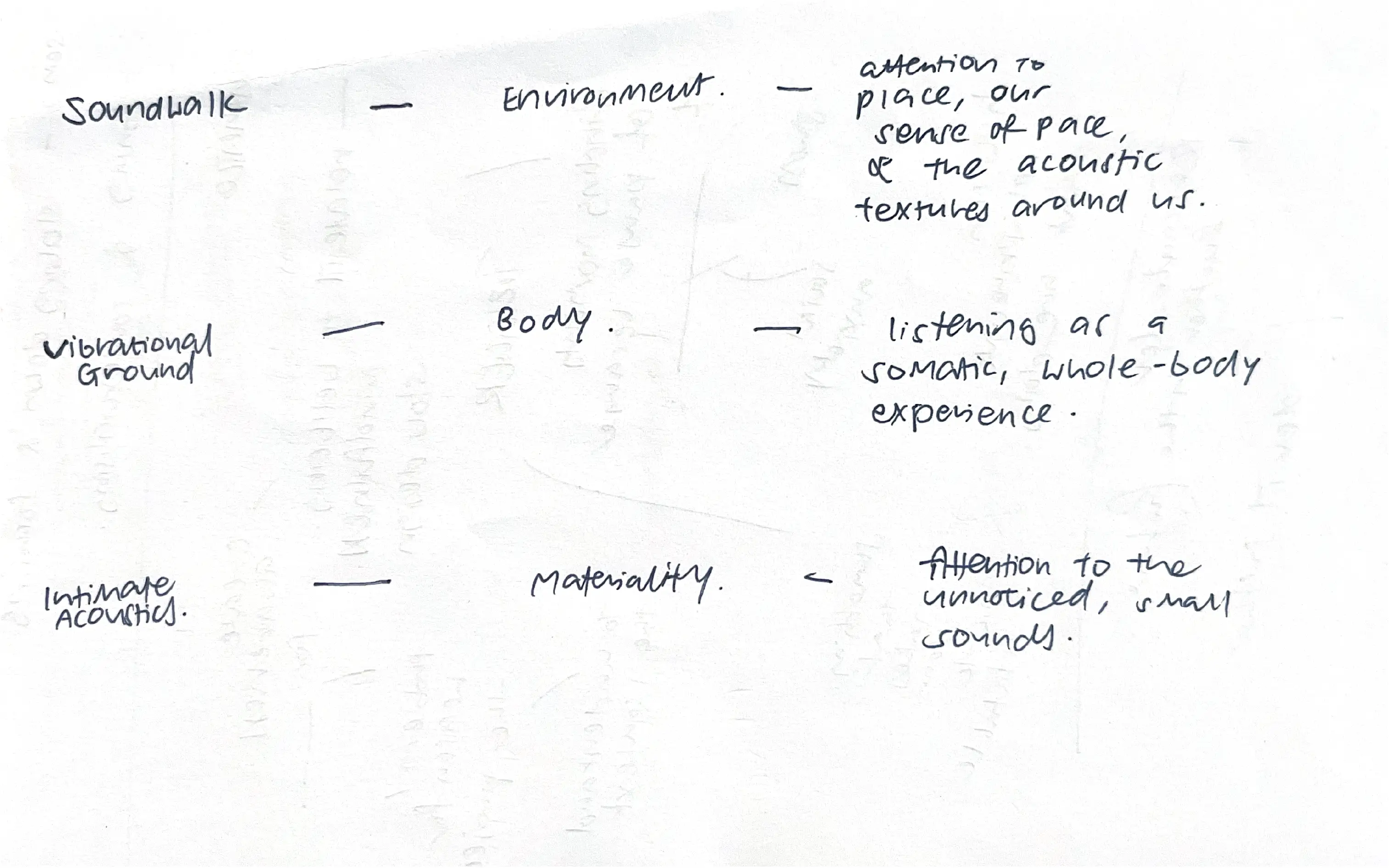
I started to piece together the milestones for the semester: Dissertation, Open Studios, Viva Voce, Graduation Show. Definitely, I’ll be bringing the three eventual outcomes from Semester 1 as my final work - those are: the Sound Walk, Intimate Acoustics, and Vibrational Ground. With this in mind, I started to think about how to present them.
Tying things together
Starting off with the sound walk, I have quite a few material I intend to showcase as part of my research for now. It includes: the responses from my personal and collective soundwalks, consisting of the written notebook reflections, sound recordings, pictures and clay. With the abundance of material at hand, I needed to find a way to string them together into an experience that viewers might understand clearly. How might a newcomer understand what sound walking is? How might they realise what has been done, the meaning behind it all, and interpret the responses in a clear and concise manner?
The sound walk itself is a very conceptual and expressive part of my project. It marks the first step of listening more intently, utilising walking as a method to understand our acoustic environments. And I guess because of how seemingly abstract it is, I really have to find a good way to present everything in simple, understandable bits. After all, the word “soundwalking” isn’t common, especially in urban Singapore.
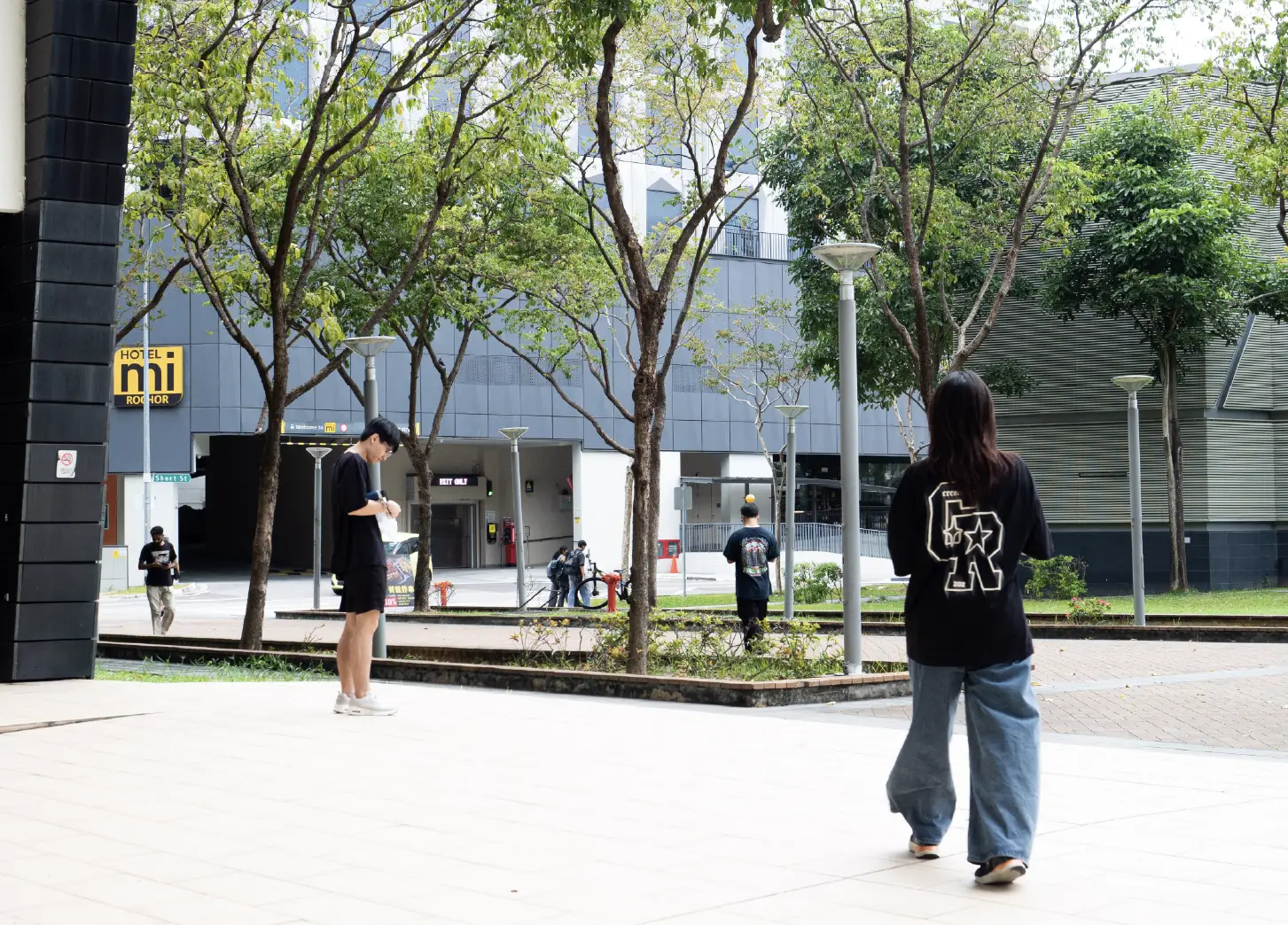
Soundwalk done in Semester 1
On the previous walk...
I’m looking to do a second rendition of the collective soundwalk done in semester 1. Hence, I decided to do a lookback of that walk and reflect on what went right, and what could be improved.
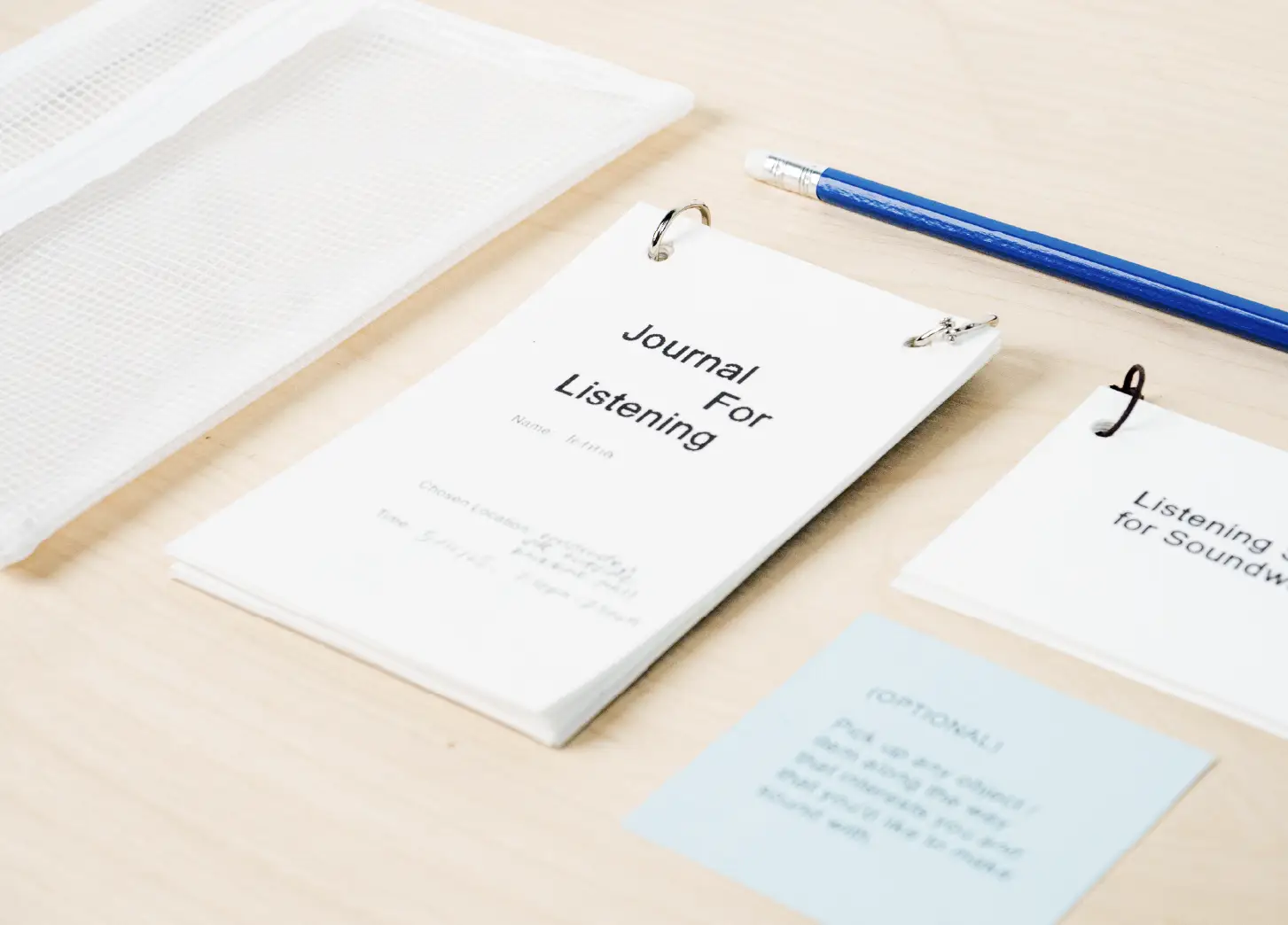
I recalled giving participants a Listening Kit, consisting of:
- 1. A flip through listening score, 5cmx7cm
- 2. Ring bound notebook, 10cmx15cm
- 3. 2B Pencil
- 4. Plastic zipper bag to keep everything inside, along with a string to hang around the body
Some remarks about the kit:
Plastic Zipper Bag
The plastic zipper bag felt too flimsy as a whole, which was a little cumbersome to take on the walk. For a first attempt, the bag also had a string attached to it for participants to wear it like a sling bag. However, the string felt like a hasty attempt to hold the bag’s contents neatly – some participants’ strings were too long, and hit against them frequently while walking. This became distracting during the walk, also creating noise that could be heard in the audio recordings.
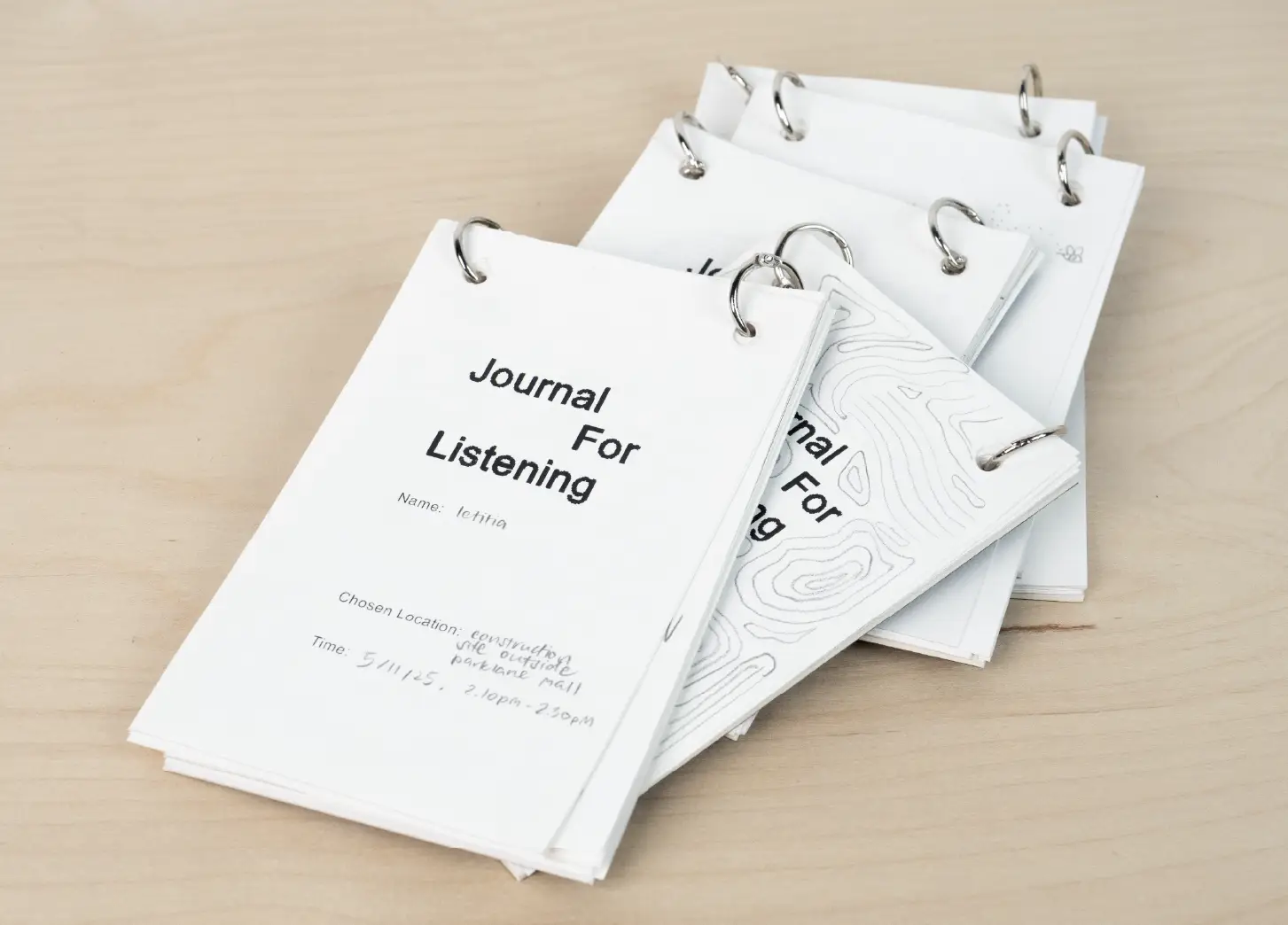
Journal For Listening
The notebook was not easy to flip through, as the small rings prevented smooth flipping. I guess I hole punched the holes at too low of an angle, making it difficult to flip the book easily. Besides this, the backing didn’t feel like a stable foundation for the book. For the next walk, I would prefer for participants to be able to write on the book freely without having to position it on a hard surface.
Soundwalk Flow:
As for the flow of the soundwalk, it was relatively okay but not the best; I was unsure of what to say at times, and stumbled over my words. Thus, my instructions might not have seemed so clear.
I had another person by my side to document photos of the participants walking around during their walk. However, as expected, it was extremely tough catching up to every person. I also felt like a distraction, sneaking up behind them to observe and take pictures.
Timing wise, I gave each participant 30 to 40 minutes to walk around. I noticed that some took longer than usual, whereas others took a shorter duration to do the walk. Some got distracted more easily by visual distractions they came across on their walk, as they got restless during the long period of time. This defeated the purpose of a soundwalk – and made me rethink about the location the walk was conducted in. In my next iteration, perhaps I could choose a place that wasn’t too distracting or noisy?
Location & Tiny Issues
I chose Lasalle as a location back then due to time constrains, and also for convenience sake. Since it was my first time conducting a soundwalk, I selected a familiar place so that I could feel comfortable enough to guide my peers along the walk. Thinking back, that location felt too familiar; so familiar that my participants didn’t exactly take the time to explore and really listen to their surroundings.
On another note, I realised that a typical soundwalk doesn’t really involve holding a book and flipping it all the way and drawing….although it is effective for documenting real life thoughts and feelings. However, I noticed that my participants were more focused on jotting and drawing instead of simply pausing to listen to the sounds around them.
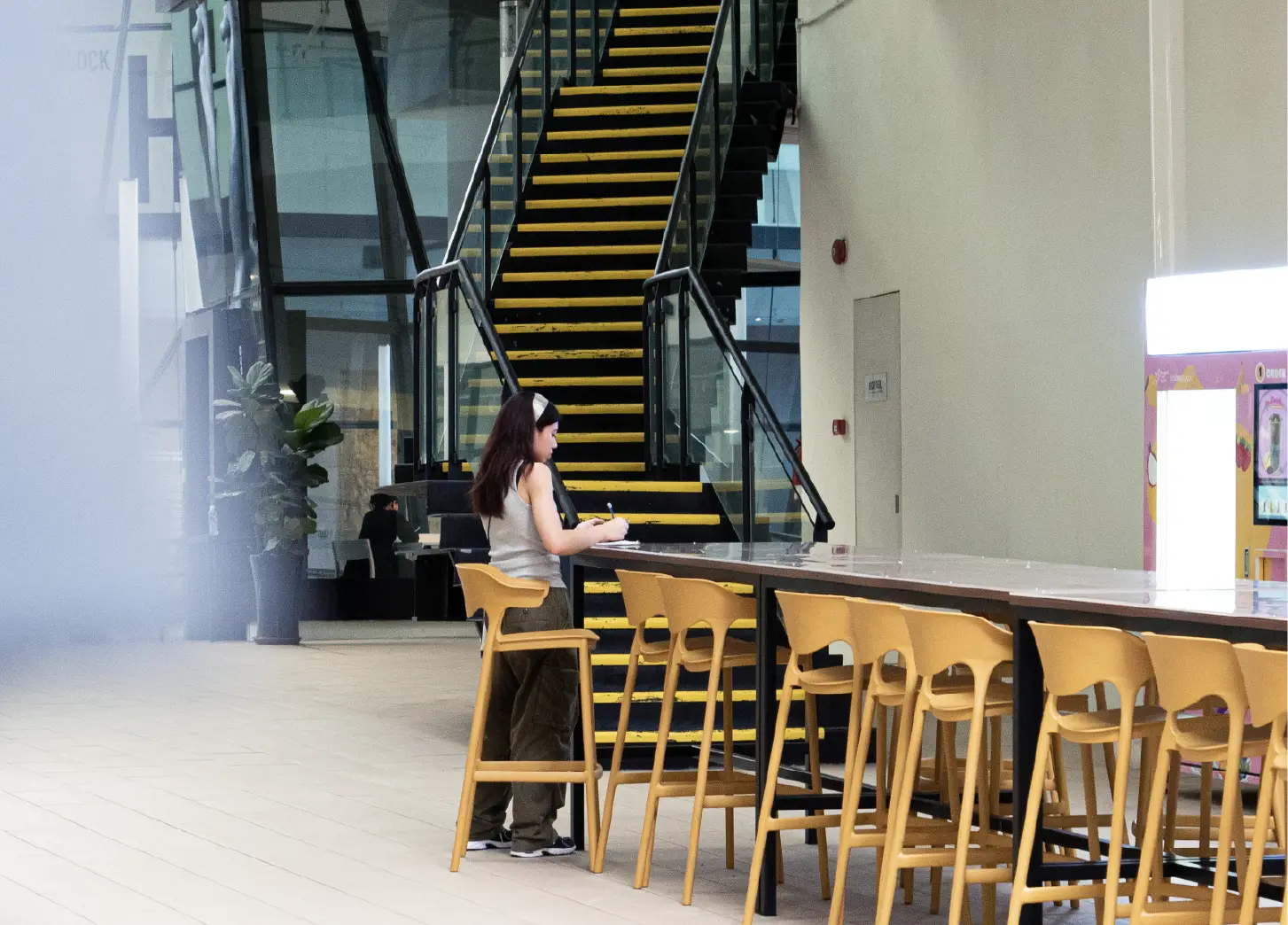
A participant writing notes during the walk
Thinking of ways to present the responses collected from the SoundWalk
I thought about putting an immersive touch to the clay pieces the soundwalk participants did. So instead of presenting the sound recordings collected as it is, I considered adding a touch element to the overall presentation. Thus, when anyone touches the clay piece, their sound recordings will play from a nearby speaker.
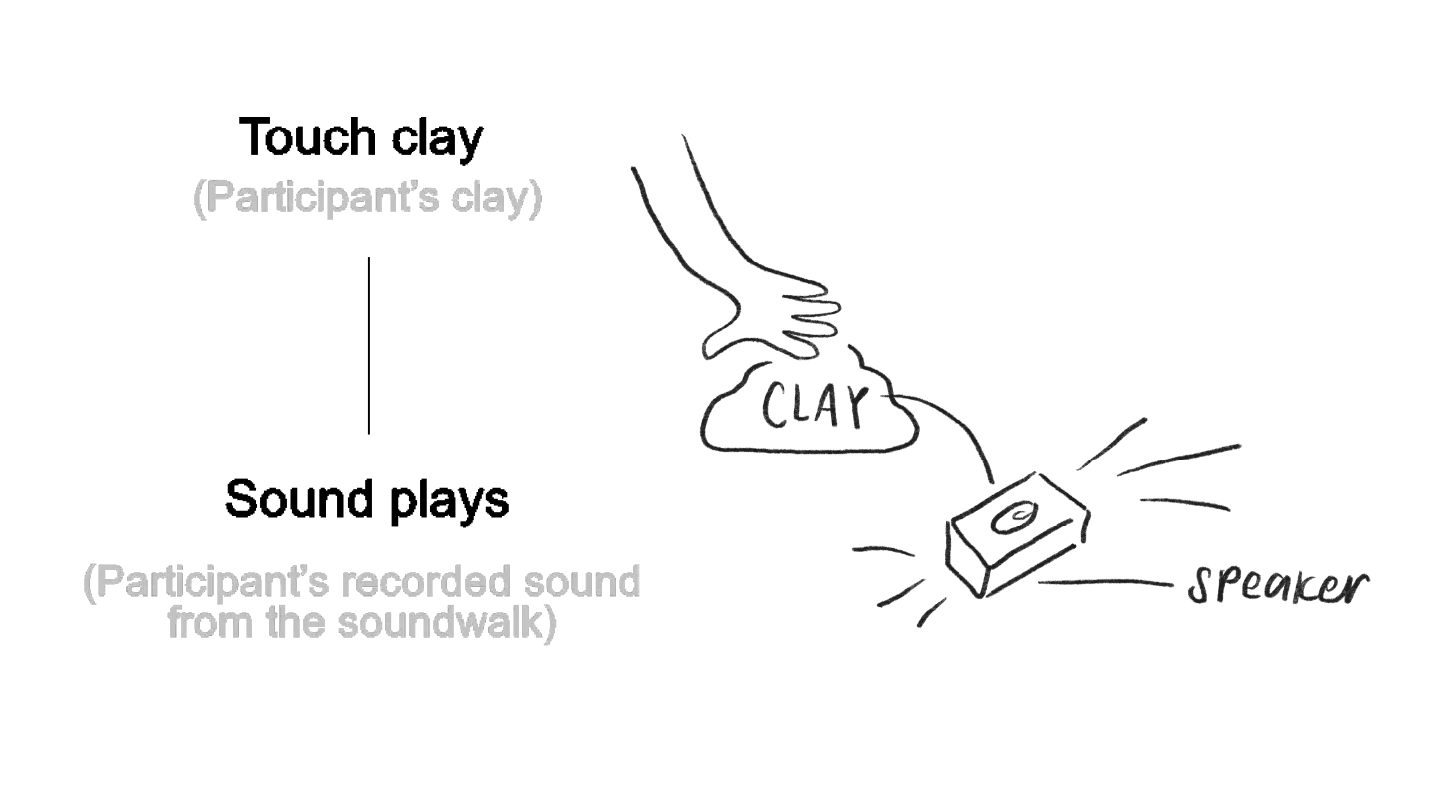
A sketch of the vision
Clay-Touch-Sound Trials
With this in mind, I did a little research and of course, asked my good buddy Claude about my plan, to get a gauge of the wiring schematic.
I needed:
- → Adafruit MPR121 Capacitive Touch Sensor
- → DFPlayer
- → MicroSD card
- → Arduino
- → 8Ohm 3W speaker
- → Conductive paint to make the clay touch-reactive
The system works by coating the clay in conductive paint - when a wire in contact with the surface is touched, readings are sent to the touch sensor, which triggers the DFPlayer to play sound files stored on a microSD card through the speaker.
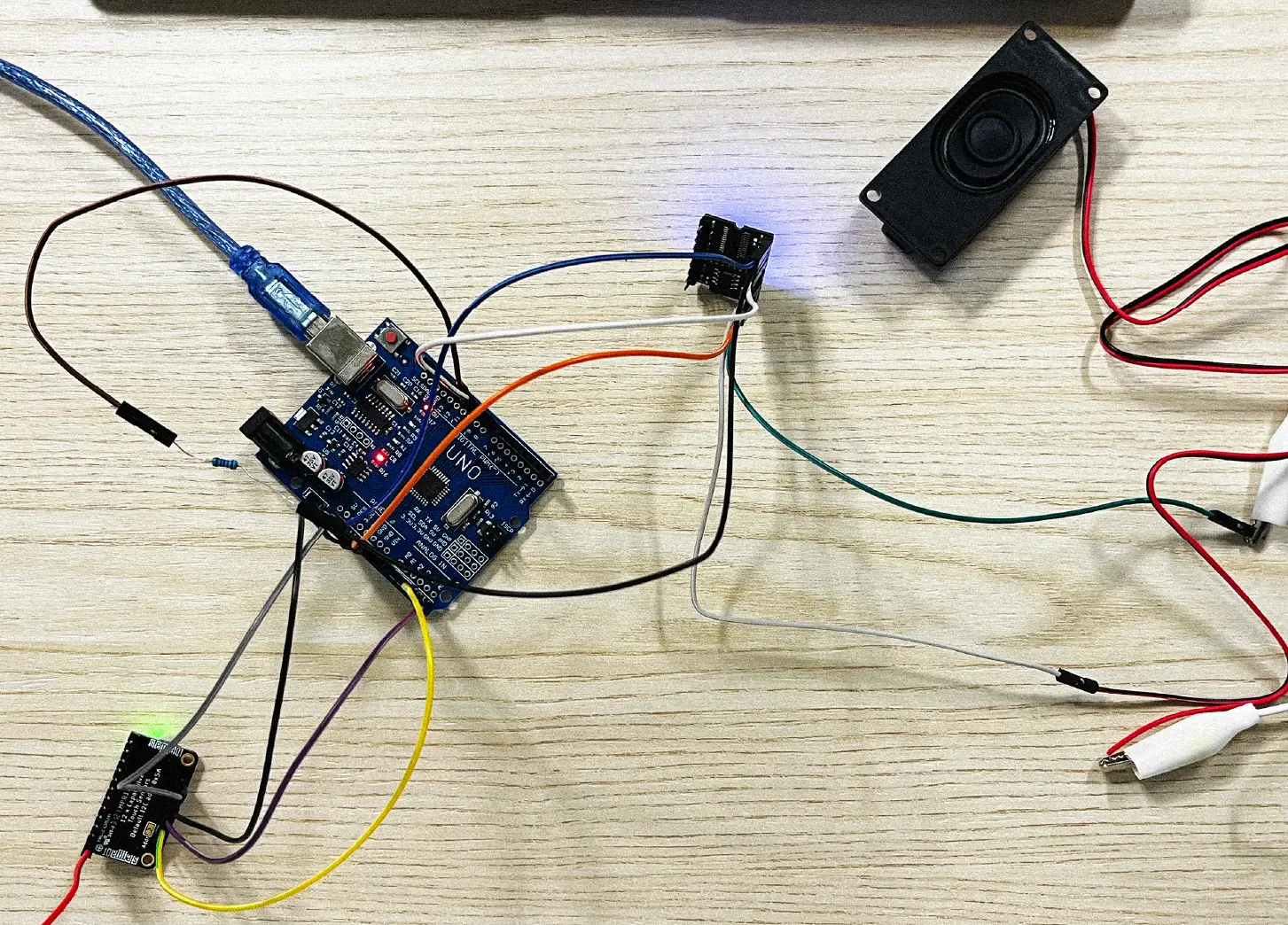
1 The full setup
2 Worked once with slight buzzing from the speaker
I was determined to get it working before the next day’s consultation, but as with all ambitious, impromptu plans and the unpredictability of electronics, progress was minimal 😀 The DFPlayer refused to play. Sometimes the code wouldn’t register any touch at all, and other times, the sound would play once but afterwards, no further activity would show in the serial monitor. After consulting Claude, I learned this was likely due to the DFPlayer freezing up the loop after the first trigger. It was a frustrating week for this pursuit, but I will continue troubleshooting it.
Vibrational Ground: Testing out new materials for the pillow
Arduino trial aside, I got to work thinking and researching on new material to craft my vibrational pillow with. In Semester 1, the air pillows and cardboard used weren’t the best - it looked alright, but I found that the exciters overheated after a while due to the air pillows trapping heat. It also wasn't comfortable to rest on given its hard surface, and the outer material produced a slight squeaking sound when skin glided across it.
I did a little research:
What material could amplify vibrations and sound? And what came up was not very surprising - search results suggesting sound dampening material, sound absorbent foam, ways to sound proof a room … In a world obsessed with reducing noise, searching for materials that amplify sound vibrations was akin to going against the norm.
Nonetheless, I decided to start off with some EVA foam and small ceramic tiles I found in Art Friend. I figured, why not try? The goal was to find materials that are slightly softer and more inviting, amplifies the vibrations well and wasn’t too thick.
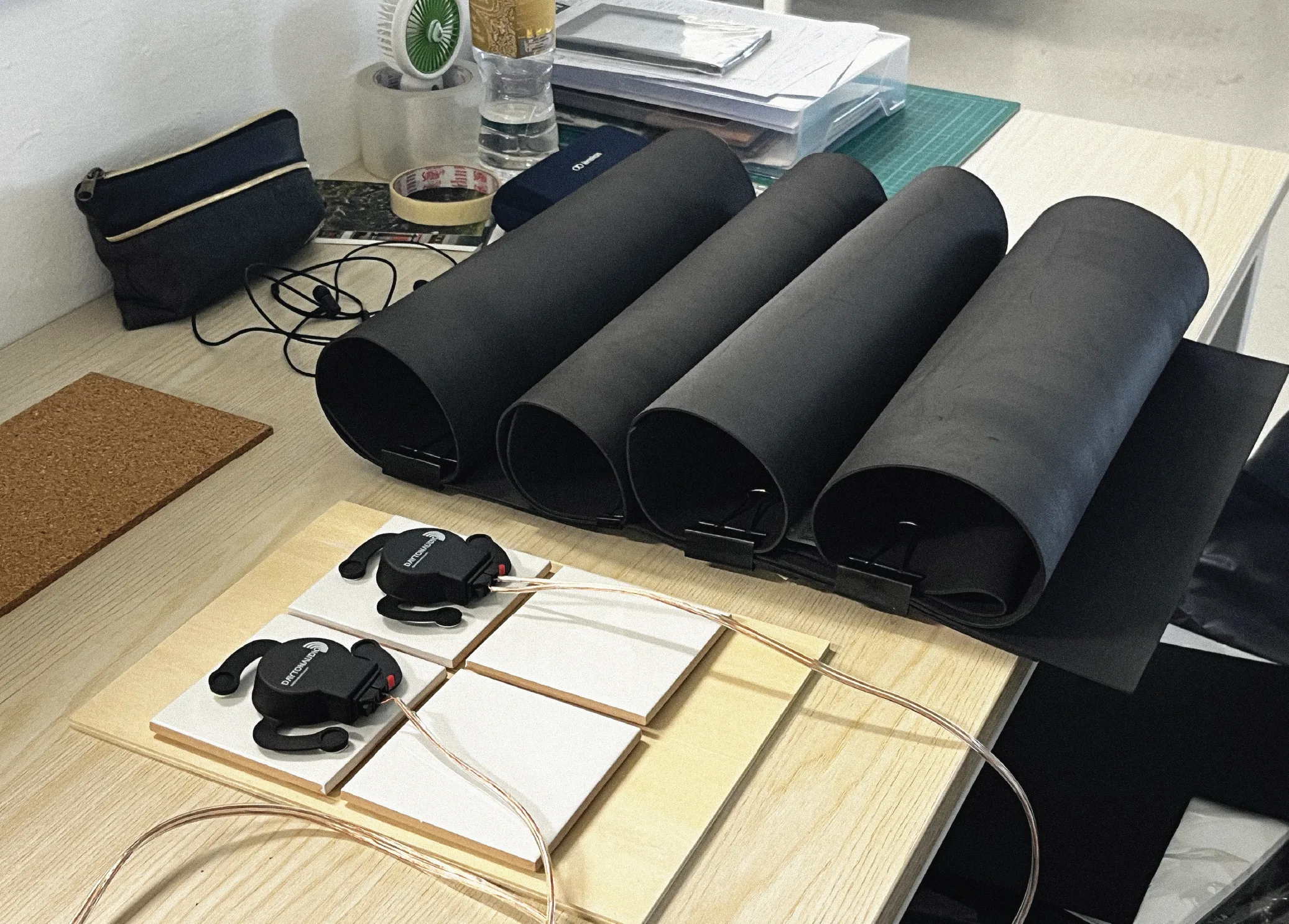
EVA Foam, porcelain tiles and exciters
Next came the revisions for the sound. This time round, I wanted to give the sounds more context - instead of random low frequency vibrations playing through the pillow, with not much context at all, I thought about sampling environmental sounds. These could be the sounds already collected from my field recordings, sampling the urban and natural. Linking it back to the project’s goal of using sound as a tool to reconnect with the environment, I thought it might be more meaningful if the sound we “listened” to in the pillow were sampled by real-world sounds. This time, I am bringing more attention to the sounds in our everyday environment, presenting it in a sensorial way. Taking everyday sounds and transforming them into low frequency vibrations, so that they can be felt and experienced much deeply.
Recording of birds
For the first trial, I used the recording of birds in a park, and loaded it onto Reaper. I attempted to extract the low-frequency parts of the track and amplify them, so that the sound played is purely of the birds. Some parts were a little tough to control as I was sampling the birds purely from the track, which meant that I was distorting the track.
Hence it came off unnatural-sounding and slightly pitchy, especially when played through the exciters - since the exciters aren’t your regular music speakers. I knew that this first trial track needed to be refined more to get the desired sound I wanted, but it also seemed a little off so I wasn’t too sure about the sound overall.