Vibrational Ground, messy tables
Vibrational Ground: Switching things up
Looking back at the past material explorations for the vibrational pillow, I felt that the sounds I experimented with fell a little flat. The central question was: how can I translate the sounds of the environment into a tactile, felt experience? And that's when I realised that there is simply no way one single pillow can express this. A single sound is not enough to capture everything around us, let alone translate it into vibrations.
I came up with an idea, just two weeks before the dissertation deadline: create four platforms, each with a unique sound, to express the vibrational qualities of our environment across four categories: natural, mechanical, human, and kinetic. I thought four platforms was the most optimal way, as it would allow audiences to compare the felt vibration between each category in more detail. As a whole, in an exhibition context, Vibrational Ground provides a more sensory experience, and feels a lot more engaging than just a single pillow.

Sketch of the four platforms"
With this thought, there was no time left to lose. I needed to produce the sounds, wire the platforms, and try a new material for the exciters to rest on fast (wood simply wasn't cutting it). Within a span of two weeks, I visited Continental Electronics and Kuriousity at Sim Lim at least four times, and got everything I needed to wire the platforms. (My money is gone now)
This time, I decided to use acrylic sheets as a base for the exciters. After much research, there was feedback that 3-4mm acrylic is pretty good for vibrational and auditory transmission, so I decided to go ahead and try that for this round. Together with Jared and Carissa, I visited Dama Acrylics to obtain sheets in varying thicknesses: 2, 3, and 4mm. I wanted the platforms to appear subtle and not too distracting, so I chose clear acrylic for a transparent and simple look.
Besides, the main goal is not the appearance,
but the sound.
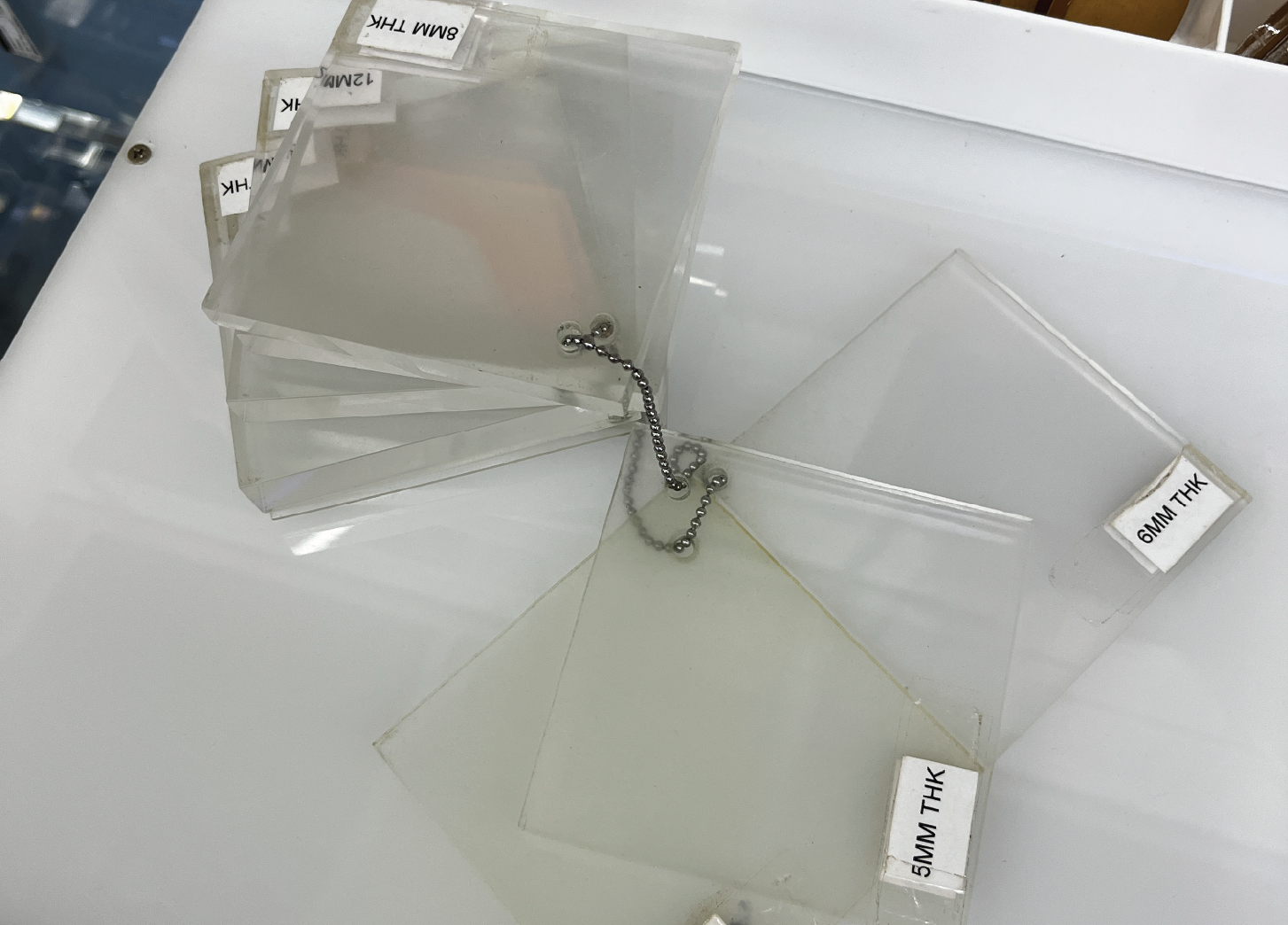
A visit to Dama Acrylics
Wiring everything together
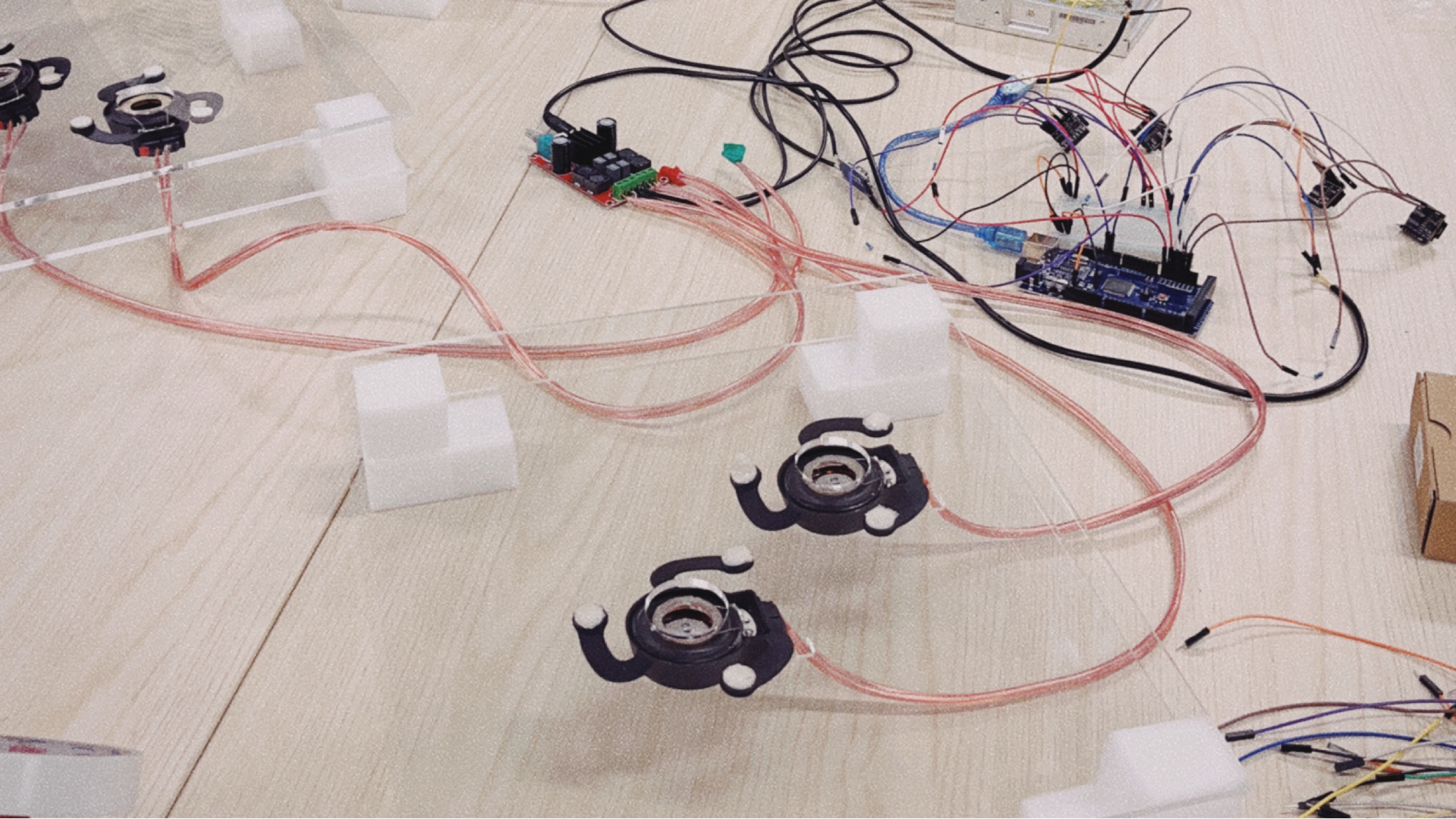
Figuring out the wiring was a nightmare. For four platforms and four different sounds, playing everything at the same time required an Arduino Mega, a 12V power supply, four DFPlayers, two TPA3116 amplifier boards, and a lot of prayer. At this point, I wasn't sure if I was overcomplicating things or just overthinking everything. I think because of the number of things I needed to wire, it felt like an overwhelming task and I was quite unconfident about it. Nonetheless, I pushed through, wired everything, failed a bunch of times, and finally got things to start working after wiring and rewiring multiple times.
For a reality check, I really needed to work in a more organised manner. Because of the amount of wires, I found that I got confused sometimes and wired things wrongly, which led to a considerable amount of time wasted. Thankfully, with some mini breadboards and proper wire management, I got things working and sorted out once everything was settled.
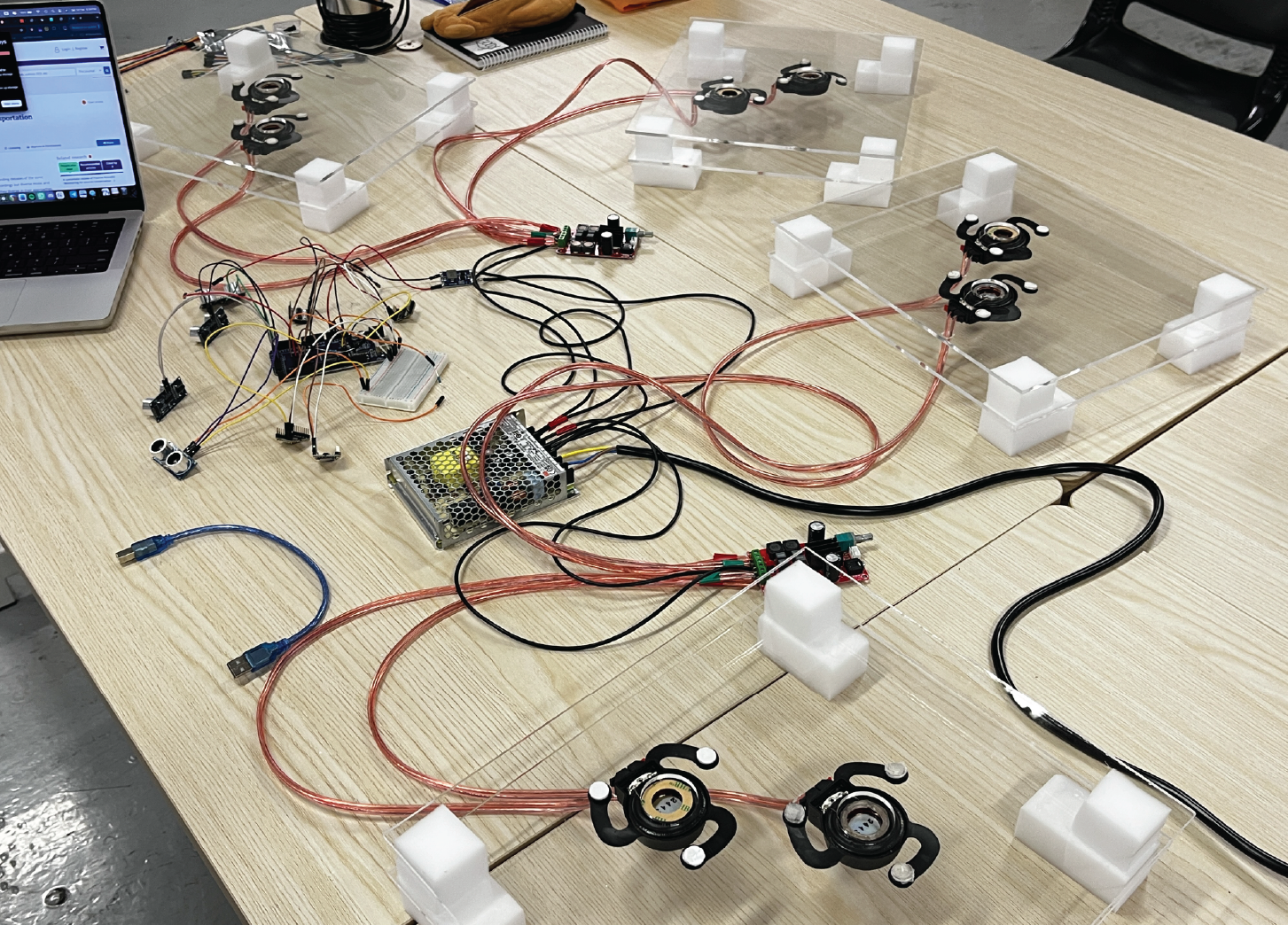
Wiring, wiring, wiring
Sound
For the sound, I used field recordings from the previous semester, which spanned from escalator sounds, to leaves rustling, human speech, and footsteps. This time, instead of simply editing the sound in Reaper to amplify its low-frequency vibrations, I used a mix of both workflows: Reaper to amplify the low-frequency qualities and pre-edit the raw sound itself, then Strudel to bring out its full vibrations and add some atmosphere to each sound file. This maintained a better balance between the two, and the resulting sound files were cleaner and closer to what I wanted it to be. (a mix of abstract and realness)
The final look, my final straw
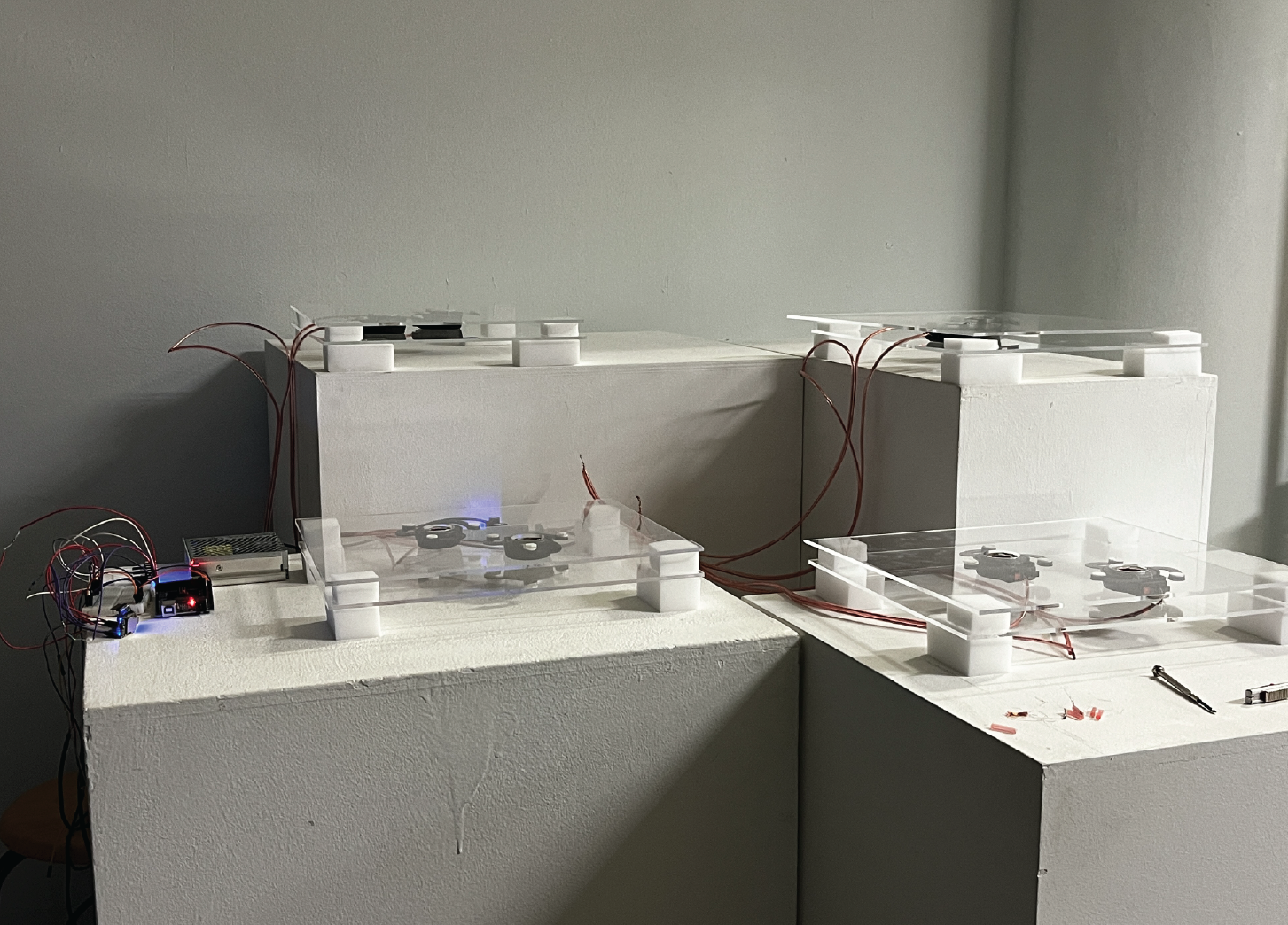
For each platform, two exciters are attached, a reasonable number for maximum vibration. Going back to the laser cutting room, I cut the acrylic to a 35x40cm size, a rectangular shape that isn't too small or too big for one's hands to rest on. Due to laser cutting constraints, I only cut 3mm this time round, and attached two 3mm sheets together for maximum effect. The final look was: an acrylic sheet as the base, with the exciters attached to it, followed by another sheet, cushioned by small hard foam. Everything is held up by four pieces of hard foam, which is stable and solid. I used the foam as I wanted a "stand" for the acrylic, and it's light and simple to attach.
Besides the acrylic, I also used upholstery foam for the covering, so that the platforms are smooth and nice to touch. I chose the foam as it was soft and inviting, and came in a nice blue colour which looked calming. In fact, despite how thick it was, the vibrations came through just fine. Thank the stars, everything was working as intended and I documented everything well before the dissertation deadline.
Honestly?
The acrylic worked pretty well for the vibrations and sound. I think out of all the material options tried thus far, acrylic is the best choice as the vibrations were clear, and its transparent nature made them look more apparent. I also liked the clean look it gave; I might stick to this material for this experiment.
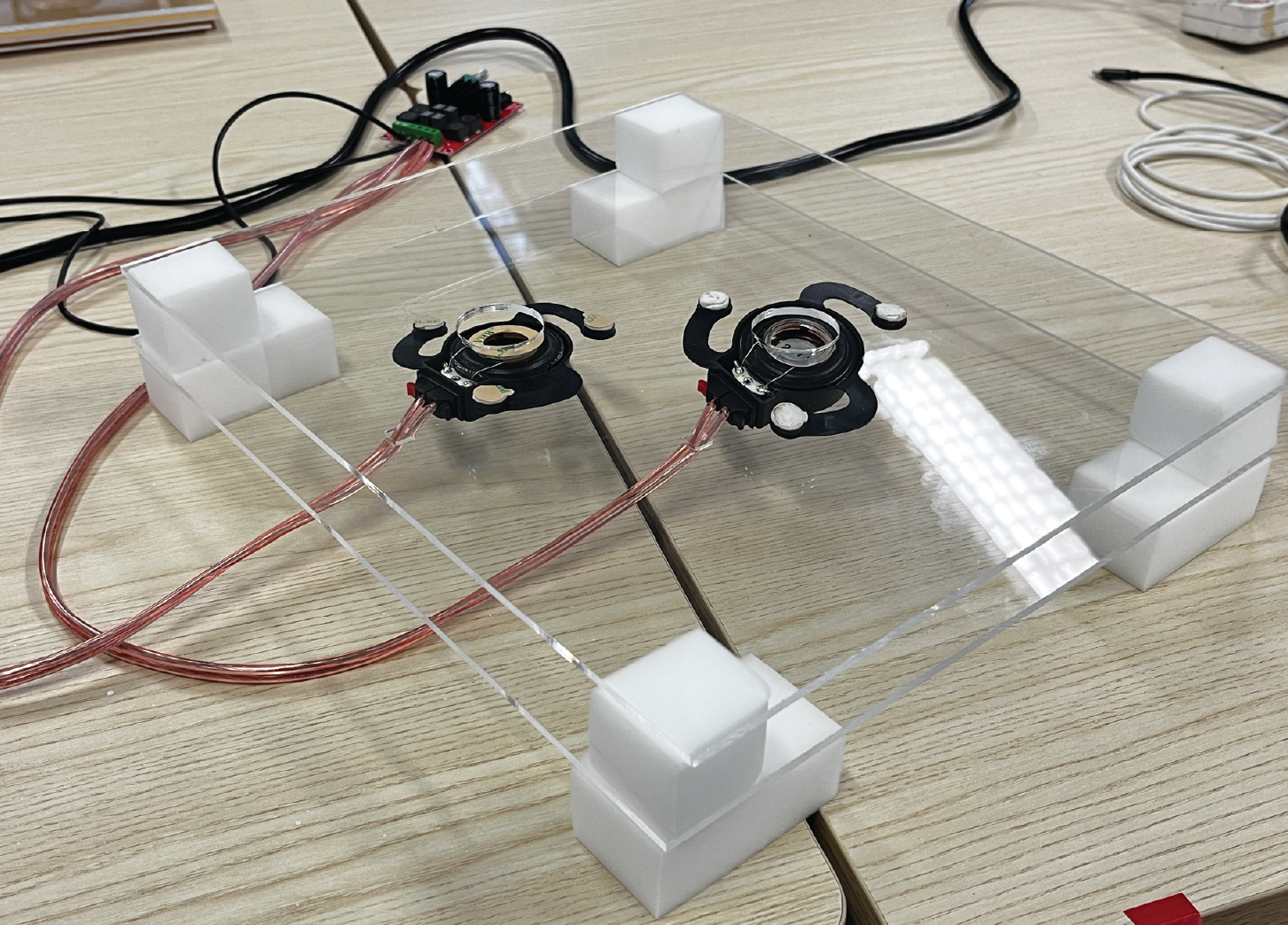
Exciters wedged between two acrylic panels
Sound-wise, I will continue to work on the vibrations, as I noticed a few inconsistencies when spread out across the platforms; some vibrations are too strong or too similar when placed together, and some platforms played the same sound for some reason, probably because of the wiring. For now, I will be working on finishing my dissertation; all the technical stuff shall be prioritised later.