Sonic Attune –
Scrambling
This week was a tough one. With Open Studios a week away, I needed to get a lot of things wired and fully ready, and it was a scramble to tie all the loose ends together and make the work appear understandable and interactive.
A gargantuan task in itself, especially for my second prototype, Intimate Acoustics. Wiring everything and curating the sounds, interactions, and distances proved harder than anything I had worked on
so far.
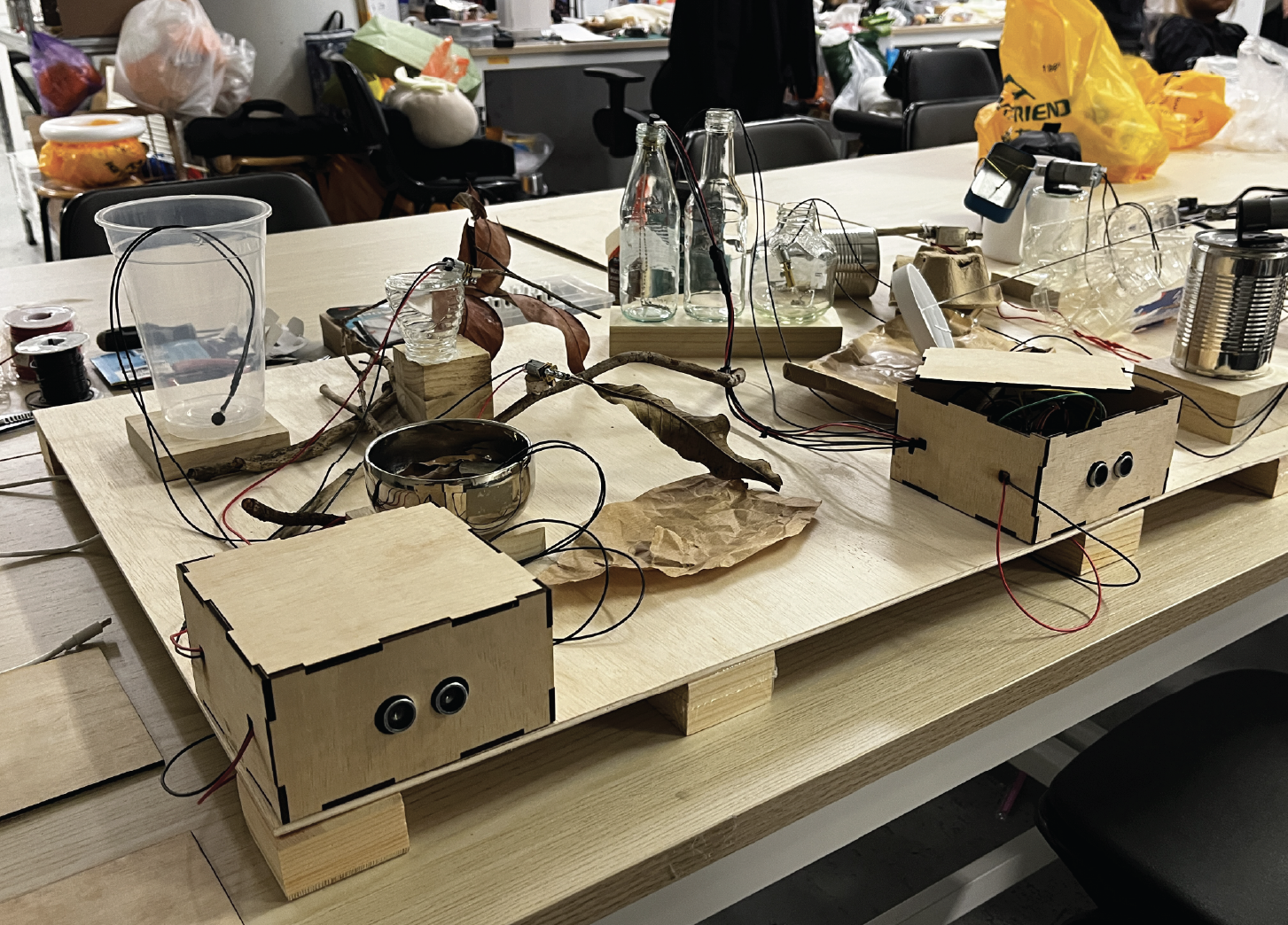
Wiring, wiring, wiring
I spent most of the week wiring and arranging the found objects for Intimate Acoustics. In the end, I got myself a piece of long plywood, stretching nearly three-quarters the length of the table. With this wood finally in my hands, I got to work sticking things down and making noise with them.
I severely underestimated how long wiring the prototype would take. The setup involved four motors attached to each ultrasonic sensor, with three sensors spread across the table. The idea was simple: when someone steps close, the sensors would trigger the motors, which will strike the objects and create sound.
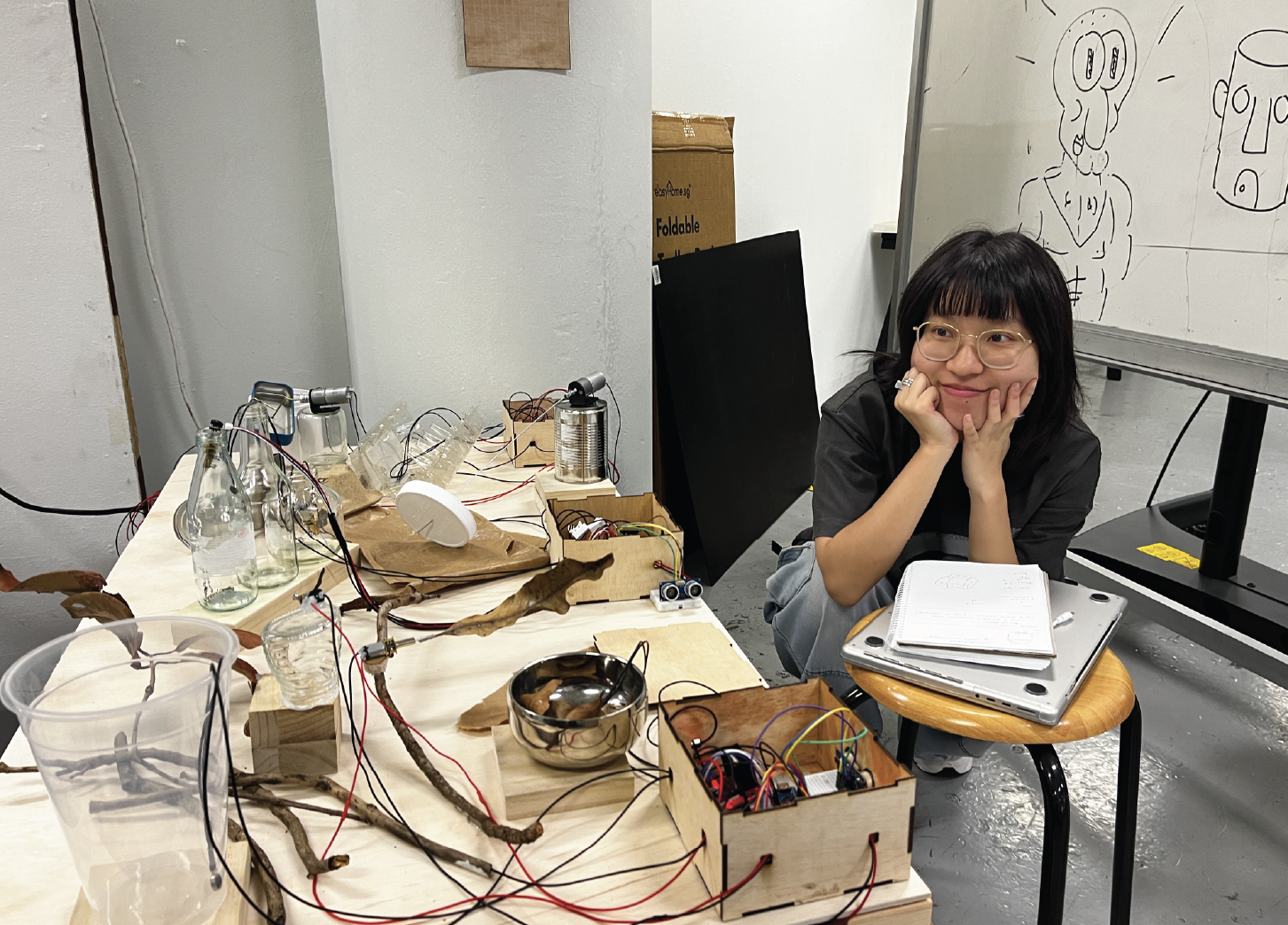
Me beside my setup, wiring all day
It turned out tougher than I imagined. Each object had to be carefully chosen to produce a certain quality of sound, ideally something soft, since the heart of the experiment was about appreciating the smaller sounds in life. It took a lot of trial and error. The leaves and twigs ended up working best, producing gentle, percussive sounds when a motor tapped against them or dragged them across a surface. However, due to the fragile nature of the leaves and twigs, many of them snapped while I experimented with them, so I needed to get backups every now and then.
To hide the mess of jumper wires, I laser-cut small wooden boxes to house the breadboard and Arduino, with only the ultrasonic sensor poking out to detect people's presence. The boxes were simple, and I liked how they turned out. They almost reminded me of Wall-E, with the sensor jutting out like eyes. I chose wood so they would blend in with the rest of the setup, and be as unnoticeable as possible. Among the stress, I was reminded of how important it was to remain calm. When electronics fail and everything is a mess, one must not panic, like I did. With the adrenaline and rush of things, I made plenty of mistakes, leading to repeated steps and a lot of wasted time. Rookie mistake!
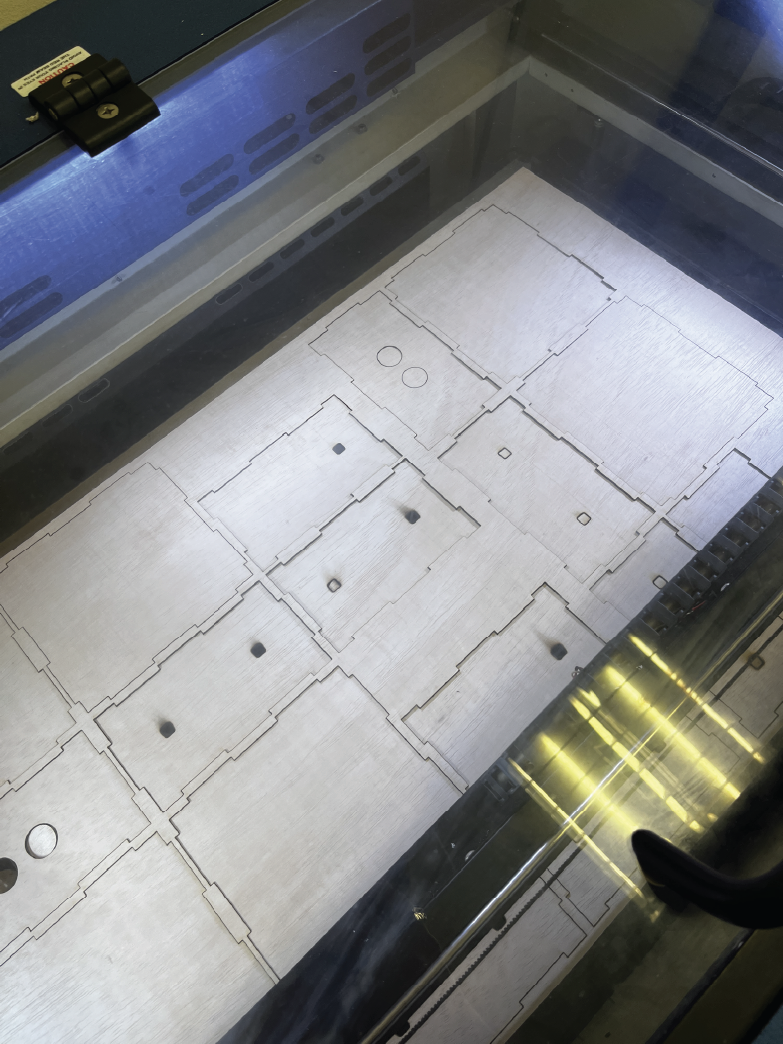
Lasercutting boxes
Open Studios Set Up
I moved things around quite a bit for Open Studios. For the first setup, I placed the Vibrational Ground platforms across four pedestals, the same arrangement I used for the dissertation documentation. Each platform needed its own breathing space so the vibrations wouldn't spill over into each other.
I thought it was also gives viewers a chance to compare the different environmental vibrations, experiencing each one at a time. In addition, I varied the heights of the pedestals so that nothing felt awkwardly positioned; the work can be experienced from all sides and angles.
By itself, this already takes up a lot of space. Hence, the table holding Intimate Acoustics was positioned in a vertical way, to be experienced from the other side. As for the items for the sound walk, I decided to use a pedestal to hold my stuff instead, and reduced it to one publication, listening score, notebook response, and clay response. There seemed to be no space for a pair of headphones and arduino, to carry out the touch conductive vision I wanted.
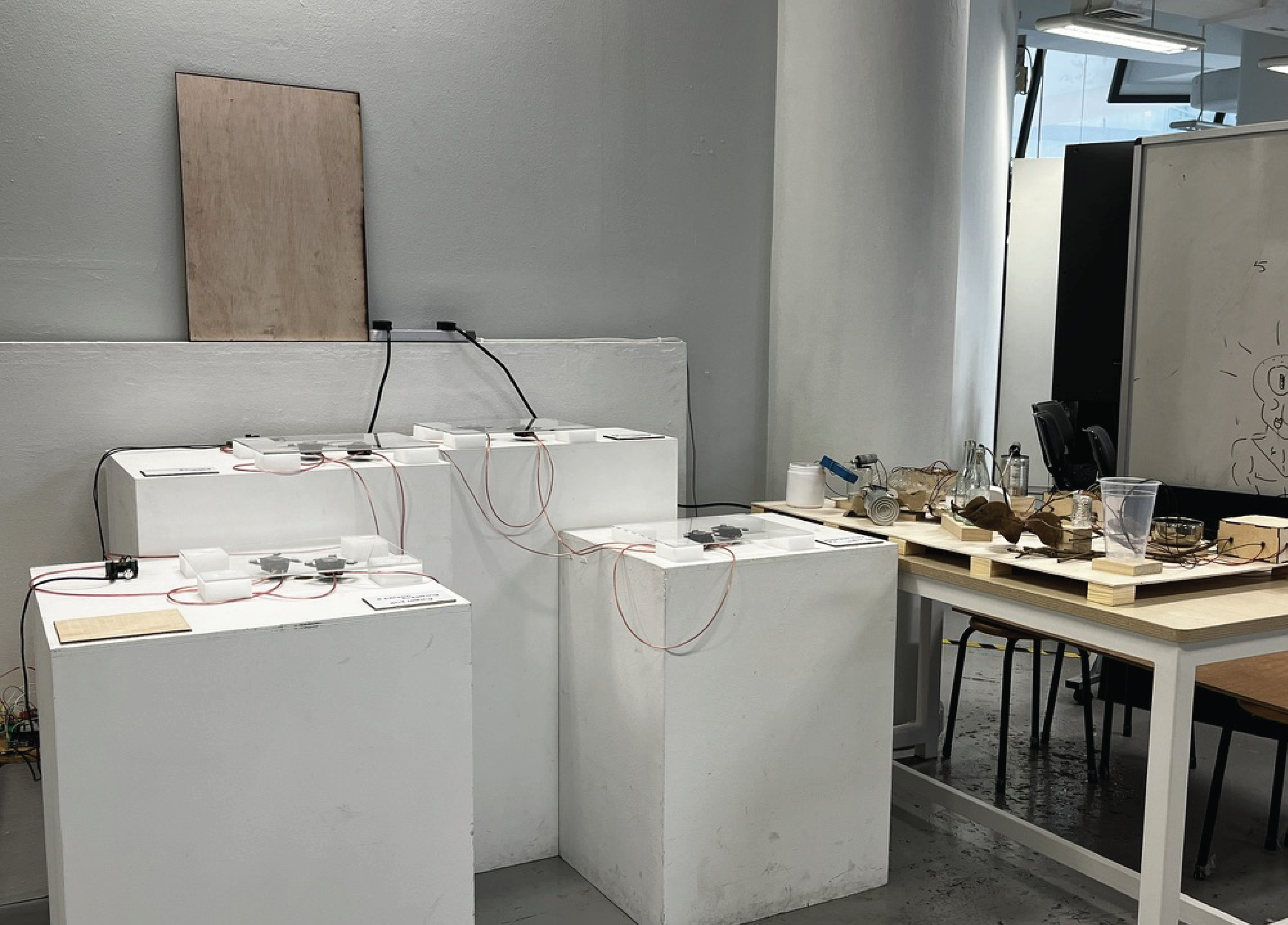
Initial setup
In the end, due to space constraints and other circumstances, I reduced the Vibrational Ground setup down to three pedestals, with a fourth pedestal on the left to hold the Soundwalk materials. Intimate Acoustics now rests on another long wooden plank, supported by nine stools, since I can no longer use the table.
Initially, I wanted to imprint the text and visuals directly onto wood, to keep things organic and raw, in keeping with the grounded spirit of the project. I tried imprinting onto plywood, with mixed results, some worked, others didn't. After a few attempts, I had to let the idea go. The method took too long to clean up, and there were more pressing things to wire and finish.
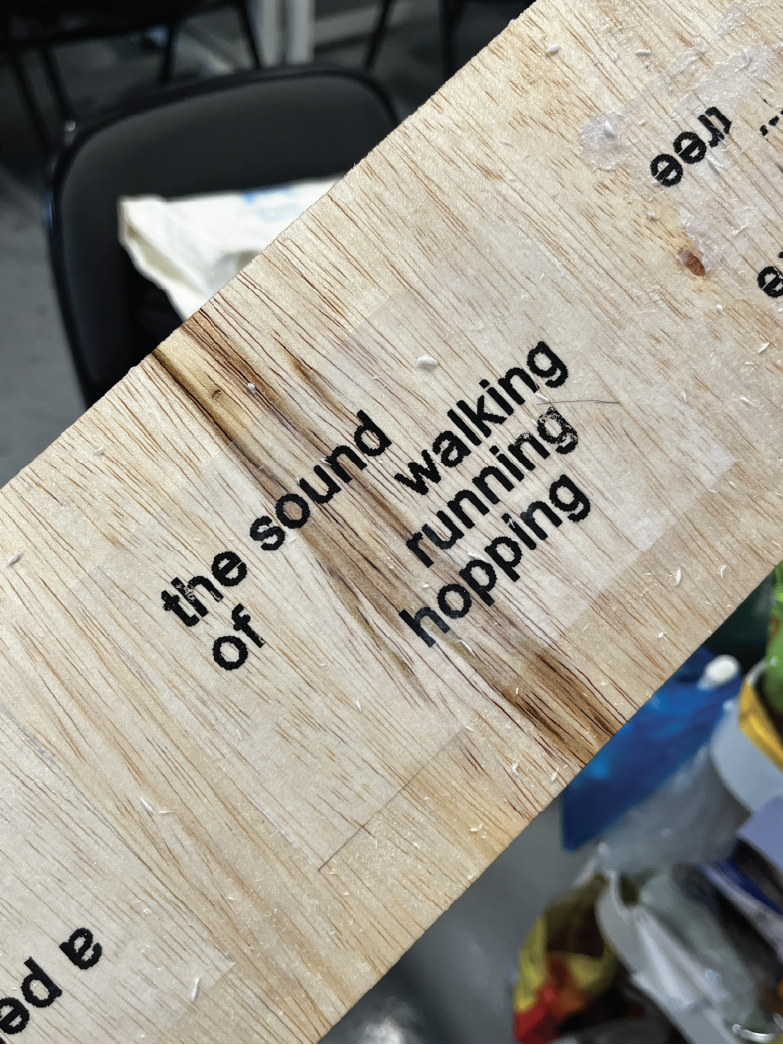
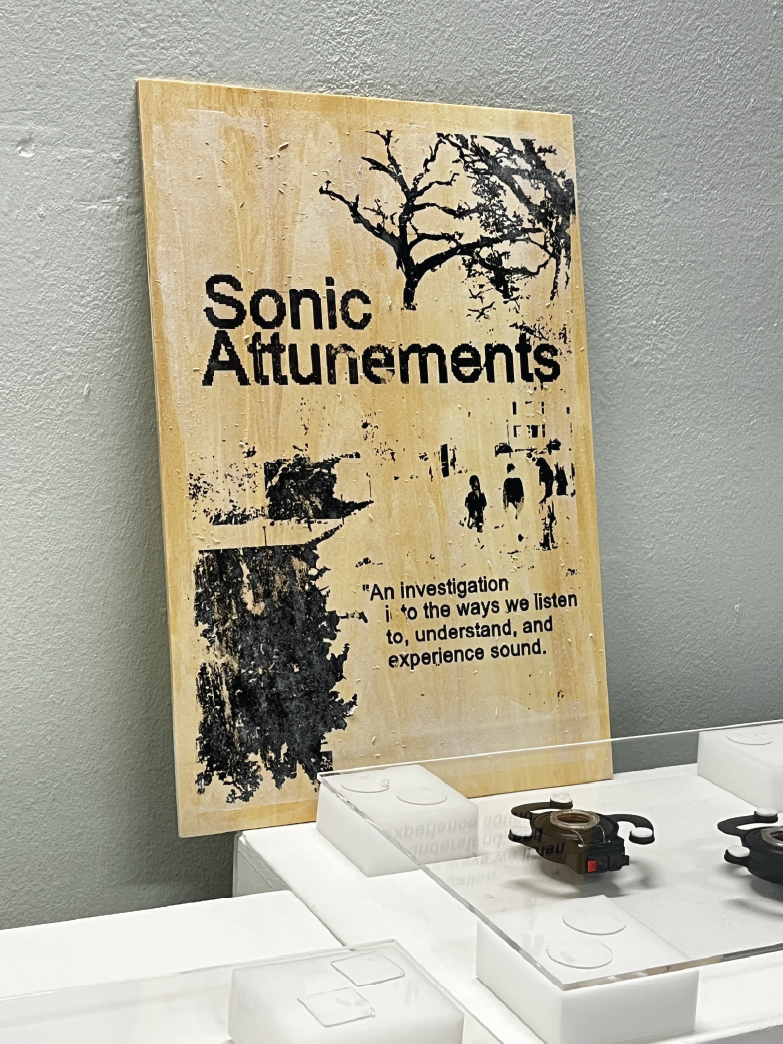
Trials with rubbing paper off wood, to achieve graphics on wood.